
-
Description
-
Articles (21)
-
Interviews
I’m an Indian novelist, playwright, short story, non-fiction ‘n articles writer, translator, a ‘little’ thinker and a budding philosopher in ‘Addendum to Evolution: Origins of the World by Eastern Speculative Philosophy’ that was originally published in The Examined Life On-Line Philosophy Journal, Vol. 05 Issue 18, Summer 2004.
Born on 27 Aug 1948 and schooled in letter-writing, I’ve articulated my managerial ideas in thirty-odd published articles, and later penned Benign Flame: Saga of Love, Jewel-less Crown: Saga of Life, Crossing the Mirage: Passing through youth (plot and character driven novels), Glaring Shadow: A stream of consciousness novel, Prey on the Prowl: A Crime Novel, Of No Avail: Web of wedlock, a novella, Stories Varied: A Book of Short Stories, and Onto the Stage: Slighted Souls and other stage and radio plays.
Then entering the arena of non-fiction with a ‘novel’ narrative of Puppets of Faith: Theory of Communal Strife (A critical appraisal of Islamic faith, Indian polity ‘n more) possibly a new genre, I ventured into the translation zone for versifying the Sanskrit epics, Vyasa’s Bhagvad-Gita (as Treatise of self-help), Valmiki’s Sundara Kãnda (as Hanuman’s Odyssey) in contemporary English idiom, and a critique Inane Interpolations in Bhagvad-Gita (An Invocation for Their Revocation).
And in the end, as a prodigal son, I returned to my mother tongue, Telugu, to craft the short story తప్పటడుగులు (Missteps).
While my fiction had emanated from my conviction that for it to impact readers, it should be the soulful rendering of characters rooted in their native soil but not the hotchpotch of local and alien caricatures sketched on a hybrid canvas, all my body of work was borne out of my passion for writing, matched only by my love for language.
My body of work as above is in the public domain as free ebooks https://g.co/kgs/bGUEqt
Besides, some of my published articles on management issues, general insurance topics, literary matters, and political affairs in The Hindu, The Economic Times, The Financial Express, The Purchase, The Insurance Times, Triveni, Boloji.com are at Academia.edu https://independent.academia.edu/BulusuSMurthy
I, a graduate mechanical engineer from Birla Institute of Technology, Mesra, Ranchi, India, had been a Hyderabad-based Insurance Surveyor and Loss Assessor for over thirty years.
I take keen interest in politics of the day, have an ear for Carnatic and Hindustani classical music and had been a passionate Bridge player.
I’m married, to a housewife, with two sons, the elder one a PhD in Finance, and the younger a Master in Engineering.

A Word To Milords
Seldom, if at all, do the proponents as well as the opponents of the vexed collegium system delve much into the antecedents of its coming into being.
So, here we go; first, in pursuance of a committed judiciary, it was Justice AN Ray’s elevation, by the supersession of three senor most Supreme Court judges in 1973, followed by the side-lining of Justice HR Khanna in 1977 for having been the sole defender of the citizen’s right to life and liberty during India’s infamous internal emergency. Then, adding insult to injury was the 1980 direct induction of Justice Baharul Islam, the jurist-politician, on the vaunted bench, all orchestrated by the dictatorial daughter of the autocratic Nehru. Yet, when Indira was alive, the successive justices conceded her executive right to appoint the judges, though in consultation with the Chief Justice (First Judges case, 1981). It was only a decade after her death that the judiciary made bold to wrest the initiative from the executive with the Second Judges case (1993). But with the disarray of successive central sarkars thereafter, in 1998, the emboldened Milords through the Third Judges Case became the Lords unto themselves in their Collegium Rings. That is fencing themselves from the executive arm, once and for all.
Now that they had long avenged their slights and had the last laugh too a decade back in negating the NJAC Act, it’s time for Milords to take stock of the untenable situation in which our judiciary has come to lay, and this word is meant just to be an aid. And what is their argument against the unanimous NJAC – the mere presence of the Union Law Minister in the selection committee of five would impinge upon judicial independence! LOL. So, by the same logic, the selected judges should be toeing the judicial line drawn by the collegium Milords, right. Oh, how specious, but they are gray-haired enough to know that independence of mind and living by the principles are the characteristics of spirited men and women, but that is just an excuse to hold on to their usurped power to further their nepotistic causes.
With around one lakh cases lying on their own benches and sixty-five lakhs in high courts under their watch and ward, not to speak of over five crores in the so-called lower courts, if it’s not the time for the collegium lords to self-introspect, then it has only to be at the calamity. It’s but natural that their judicial time leaves not much time for attending to the herculean task of finding the right judges to adorn the higher benches, made difficult by the prevailing state of our compromised polity. So, lacking the wherewithal to venture into the discovery channel besides being hard-pressed to dispense justice in time, is like falling between two stools. Surely, Milords cannot be unaware of the fact that they have bitten off the judicial cake more than they could chew. Why, they are even incapable of filling around thirty percent of their high court benches, not to speak of speeding up PMLA proceedings! Whatever, they could not be insensitive to the abysmal state of the judicial affairs, taken as a whole, hamstrung with mundane ailments one too many.
So, the question that naturally arises is why won’t they untangle themselves from the tangled collegium web for personal relief as well as for the public good. Well, judges are human too, and power intoxicates them no less, made worse by our extra selfish times. If, by chance, Milords have read thus far to develop second thoughts, then they may go through further for a welcome denouement.
"Ay, sir. To be honest, as this world goes, is to be one man picked out of ten thousand"- Hamlet to Polonius.
That was then, and if Shakespeare were to revise it now, Hamlet would’ve said ‘out of hundred thousand’.
So to say, the clue to the honesty drop of our times was provided by Andy Hargreaves, “There is no morality without temptation; otherwise it is just lack of opportunity”.
However, be it in the world of yore with limited opportunities or in the modern times with unlimited avenues, the honest are few and far between but the Bard of Avon wouldn’t have meant that the rest of the multitudes were patently dishonest. The master’s intent would’ve been that rarely are men innately honest but the vast majority of them lack the conviction to be upright, regardless. In other words, the bulk of the people by nature are character-neutral and by disposition are fence-sitters. It’s thus, the ethos of an organization comes to be shaped by the upright or deviant, as the case may be, and that counts.
It is in this context that the exceptional thinking of the much-maligned Joseph Goebbels, expressed in his ‘Addendum to Adolf Hitler's Testament’ that brings forth another Shakespearean dictum , ”Virtue itself turns vice, being misapplied, / And vice sometime by action dignified", becomes eminently relevant.
“The Führer has ordered me, in the event of the collapse of the defense, to leave the Reich capital Berlin and to participate as a leading member in a government appointed by him.
For the first time in my life I must categorically refuse to obey an order of the Führer. My wife and my children join me in this refusal. Otherwise—quite apart from the fact that for human reasons and reasons of personal loyalty we could never bring ourselves to leave the Führer alone in his most difficult hour—I would regard myself for the rest of my life as a dishonorable renegade and a contemptible scoundrel, who, together with his self-respect, would also lose the respect of his people, which would have to be the prerequisite for any further service by me in shaping the future of the German nation and the German Reich.
Amid the delirium of betrayal that surrounds the Führer in these critical days of the war, there must at least be some who stand by him unconditionally and unto death, even if this contradicts a formal order, however well-founded, that he expresses in his political testament.
I believe that by doing this I am rendering the best service to the German people for its future, because in the difficult times that lie ahead, examples are more important than men. There will always be men who show the nation the way to freedom. But a reconstruction of our national life would be impossible if it did not develop on the foundation of clear examples comprehensible to everyone.
For this reason, together with my wife and in the name of my children, who are too young to express themselves but who, if they were of the necessary age, would unreservedly join in this decision, I declare my irrevocable determination not to leave the Reich capital even if it falls, and rather to end a life at the Führer's side that has no personal value for me if I cannot devote it in the service of the Führer and at his side.
Given in Berlin, 29 April 1945, 5:30 a.m.
Dr. Goebbels” [Emphasis supplied]
What examples the collegium benches had set for the judges it inducts into the judicial system – Not one but two Chief Justices went judicial overboard to protect a notorious woman of judicial pedigree from being prosecuted for her wrongdoings though their brother judge said that she should be hauled up as a fraudster. While some bails have become the instruments of favour, the ideological biases emanating from some of the benches even foul the country’s atmosphere. So to say, in all such cases, miscarriage of justice is not only done but is seen to be done, without any remorse or shame, not even later-day regret. But on the contrary, the fear to face the truth grips the ultimate bench in that save the honourable Justic Gogoi exception of the Ram Janma Bhoomi litigation, it is dead scared of dispensing justice in case of Kashi, Mathura etc. That successive CJIs should lack the courage to resolve the country’s cultural vexations speaks for the lack of character and the absence of conviction in the collegium benches.
Given that our society has become grossly corrupt, by and large that is, it is a matter of segregating the honest grain from the dishonest chaff that is bound to be beyond the narrow collegium vision as that is possible only through a broad NJAC search. If anything, the scandal of the burning bundles underscores this well and true – how come Justice Verma was so unabashedly unashamed is the question. Why not; he could only be cursing his bad luck that burnt all his ill gains (is it so); how fair it is to expect him to forego whatever might be in his retirement store, especially as much of his biradari continues to make merry, without let or hindrance that is.
However, I for one believe that Justice Surya Kant is better than most of the collegium-era Chiefs and as I dedicate this word to him as it’s a product of his address in the recent Ram Jethmalani Memorial Lecture, I urge him to grasp the Goebbels moment of his destiny to change our country’s judicial course. That’s by bringing the curtains down on the ugly collegium drama that is being staged for far too long. Maybe, he can give a thought to it as it comes from the maternal grandson of the upright C. Kameswara Rao, author of ‘The Law of Damages and Compensation’ among others, who was wont to advocate only the just causes that tended the Judges of the District Court in Kakinada, where he had practiced, to pre-judge their merit.

Hindus ‘n Hebrews – Contrasting Parallels (A Case for Hindu Rashtra)
Desa-mante matti-kaadoi, desa-mante manushu-loi (nation is not (its) soil, nation is but (its) people), wrote Gurajada Appa Rao, a noted Telugu playwright and poet, and Hindus and Hebrews, aka Jews, validate him, though differently.
True, all peoples and nations have their unique attributes but few, if any, had such travails and tribulations as Hindus and Hebrews as peoples, and India and Isreal as nations, remarkably with peculiar parallels and compelling contrasts.
So to say, more than any, it is the aftermath of India’s independence and Isreal’s formation that highlights the lack of Hindu hindsight and the expansive Jewish foresight. The Hindus made their part of the sundered land, a no-man’s land, in effect a dar al-harb (abode of war) for the unobligated Musalmans that stayed back in their millions. The Hebrews, on the other hand, turned the reacquired part of their promised land into a Jewish State, despite its considerable Arab Muslim habitation. While an exhaustive study of the contrasting parallels of the Hindus and the Hebrews, indeed, India and Israel, is a tome in the waiting (maybe a joint venture), this piece is but a prelude to set its tone.
Much before Moses led the Jews to their promised land of Israel, the Devas enabled Hindus to make Bharat, their karma Bhoomi. Maybe by divine design to make them proportional to their populations, the former was shaped a tiny enclave, and the latter a subcontinent (Bharata Khanda). In Bharat, while its rishis and munis evolved the Sanatana dharma, aka Hinduism, the acharyas and gurukuls made it the seat of learning, visited by the seekers from all nations. Likewise, the chosen ‘Jewish’ people, nursed their promised land to shape its heritage, that’s narrated in the Torah, needing no repetition.
However, as if to prove that good things do not last forever, both these ancient people, in historical course, fell on bad times, first the chosen ones, and later, the blessed ones.
Being among the oldest non-proselytizing entities, they had to survive the proselytizing onslaught, from within and without: Hinduism from Buddha’s revolt, reform if you please, tumultuous Islamic assaults and the insidious Christian intrusions. Likewise, Judaism from Jesus’ rebellion, clothed in the Sermon, Muhammad’s personal animosity, crystalized as Islamic hatred, not to speak of the despicable anti-Semitism of the Christian world.
In case of Jews, first, it was the Assyrians that drove some of the them out of their land, and then the Babylonians, not only destroyed their First Temple in Jerusalem but also exiled many of them. Even their subsequent resettlement that Cyrus the Great facilitated came to naught as the Romans destroyed the Second Temple they rebuilt, and what’s worse, accentuated their diaspora, resulting in their dispersal all over. Well, that’s the price the Jews had to pay for the lack of geographic depth that still puts them on their toes in their regained State of Isreal.
As regards the Hindus, their first brush with the Islamic invasions was in the outlier Sindh that Muhammad ibn al-Qasim subdued at the dawn of the eighth century, and his brief foray thereafter into Gujarat to loot its famed Somnath shrine. However, it was three hundred years later that they had their first dish of Islmic savagery, served by ‘marauder’ Mahmud Ghazni in the sacking of the refurbished Somnath. Call it the Hindu misfortune or its cultural resilience, the cycle of Islamic destructions and Sanatana reconstructions continued, over centuries, at Somnath (five each); the in situ marvel is built, post-independence.
Whatever, had Hindus developed shatrubodh (enemy awareness) after Ghazni’s buthshikhani (idol breaking) in Somnath, maybe there would never have been even an Islamic chapter in the Indian history. Though badly mauled by Prithviraj Chauhan in the First Battle of Tarain, as Muhammad Ghori returned for the second one, a year later, had the fellow Hindu rulers joined hands with the former, the latter could not have established the Delhi Sultanate, the harbinger of India’s Islamic rule. Needless to say, it was a horrendous five-hundred-year medieval period for the Hindus thereafter that only ended after Aurangzeb’s vicious reign came to an end, and that hastened the decline and the downfall of the Mughal Empire.
However, whereas the Jewish physical toll the anti-Semitism took in the Christian world by way of pogroms, exacerbated by the holocaust of six million of them, is rightly remembered by the perpetrators, as a means of atonement of their sin; the Muslim slaughter of medieval Hindus was pushed under the carpet of collective consciousness of the world. That is even after American historian Will Durant in his book The Story of Civilization affirmed that the medieval Muslim conquest of India was "probably the bloodiest story in history", with varying genocidal estimates between eighty to hundred million dead, not to speak of the unspeakable atrocities against women. It’s as if the Hindu lives do not matter, even to the ‘civilized’ minds.
So be it, but when the Jews were forced out of their hearth and home, as some of them came to them, the Hindus welcomed them with open arms, making them feel at home ever after. Not Just that, during the World War I, fighting on the Israeli soil to liberate its Haifa from the Ottomans, scores of Hindu soldiers laid down their lives. (It goes to the credit of the Jewish people that they have not forgotten these Hindu gestures). So to say, it’s but a demonstration of their innate fighting spirit that never waned, for some of their kings were unceasing in causing military headaches to the Islamic invaders. Even in the British Raj, though the enervated princelings acquiesced to the throne, free-spirited from all sections, more so the tribals, tended to indulge in insurgencies against the colonial masters, throughout India’s length and breadth that is, for years on.
Nevertheless, whereas the Islamic invaders upset the Indian social order of yore, the British colonizers undermined the Hindu minds to their eternal detriment.
It was Lord Macaulay that established a cult of deracinated Hindus as “a class of persons Indian in blood and colour, but English in tastes, in opinions, in morals and in intellect” that rules the roost even eight decades after British had left the Indian shores for good, that was after looting whatever they could. (I too was a decedent member for long). Surely, his legacy can lay claim to prophethood. So be it, but as if to leave an inviolable mark of their colonial rule, the British partitioned India to carve out Pakistan, as a homeland for the intransigent Musalmans. It’s another matter though that having insisted that they cannot live with the Hindus, the raison d'être of partition, yet 80% of them stayed put in the 80% land allotted to the Hindus that is Bharat. But in stark contrast, the very British allotted 55% of the contested land to 33% Jews, leaving the Muslim majority with their minority share. However, owing to their religious-hate-driven military misadventure, the Muslims lost more of their meagre land as spoils of wars to Isreal. Why, the Jews know their enemy well, and it shows.
It's thus, they came to define their new State of Isreal as ‘Jewish and Democratic’, though governed by secular laws, but without a written constitution. It’s another matter that even if Moses’ Laws were enforced, the Abrahamic Arabs would have more than welcomed them but unlike Musalmans, the Jews had long since moved away from their untenable mores of yore. What is more, as if to keep their nascent nation in a wait and watch mode, they had evolved the concept of Basic Law. And for their part, the Arab Israelis, privy to the Jewish resolve to not to let anyone mess up with their promised land, not only fell in line but also fall at the front along with their Jewish mates. Whatever, the Jews, who are privy to the Islamic credos more than any, understand the consequences of a constitution that enables the Muslims to perceive Isreal as a dar-al-harb for what it is, the abode of war for the Musalmans. Hence, "the realization of the right to national self-determination in the State of Israel is exclusive to the Jewish People” formed the Basic Law, adopted by the Knesset in 2018, true, 2018.
Juxtaposing it, the Hindus gave themselves a hotchpotch constitution that declared India as a sovereign democratic republic, however, governed by communal laws in civil matters, mostly Sharia-compliant at that! That’s not all, it granted freedom of religious propagation (read Christian and Muslim proselytization) that too in the immediate wake of the country’s partition on religious lines. What a memory! So, in other words, it’s nothing but an instrument of Hindu hara-kiri; yet that they think no end of it speaks for their intellectual bankruptcy. Think that their progenitors wore Upanishadic wisdom on their sleeves and Kautilya gave them Artha Sastra that, anyway, has been collecting dust for long!
So, by design or by default, the Indian constitution was designed for the unfettered growth of the Semitic faiths of Christianity and Islam in India and their adherents too have not been found wanting in making the best of its provisions that serve as their proselyting tools. Well, at this rate, given their secular foolhardy, the Hindus, over time, by way of curing the Muslim headache they themselves bought for Bharat, could be conceding Islamic States in Assam, Bengal and Keralam, and part with part of their land in other parts of it as Sharia-compliant Autonomous Muslim Areas, a could be Islamic innovation. But would the Christians lag behind in demanding their share of the Hindu spoils. Why should they, as they already have most of the Seven Sisters in the Northeast under their Christian belt.
If that were not to be Bharat’s scary future, how the common Hindu-Hebrew fate came to be forked into differing India, Israeli destinies thus, is the subject that should engage the former for timely redressal.
While the unquestioning faith in Jehovah keeps the Jews united in the Judaic fold, the unshakeable belief in their promised destiny makes them persevere no end, and that at once affords them the feeling of oneness and a sense of purpose. It’s thus, in spite of the unceasing pogroms against them all over Europe, they kept intact their hope of returning to their promised land. Thus, it was this resolve to make it a reality that gave rise to Zionism, a political and nationalist movement with the goal of establishing and supporting a Jewish national homeland in Palestine. Indeed, Israel came into being, nine months after India became independent, and the rest is history - of the Jewish resolve to live for and die for every inch of their hard-fought land, and of the Hindu ineffectiveness in not retaining even India’s unfair share, resulting in the further loss of over 50k sqkm land to its enemies, not counting Gilgit-Baltistan.
However, for the Hindus, the Sanatana ethos of ekam sadviprā bahudhā vadanti (what is right is One only, describe it wise variedly) is no sticking glue to hang on regardless. If anything, the pristine varnashrama dharma that in the later-days degenerated into the caste conundrum, has come to irrevocably divide the Hindu socially, and became detrimental to it in every which way. Besides, Bharat’s varied regionality with distinctive languages and sub-cultures, in spite of its Hindu homogeneity, deprives it of an emotional coherence, rendering it into a sort of nation of nations. Thus, unlike the Hebrews, the Hindus have no like passion for their karma Bhoomi; maybe, its subcontinental vastness also makes it psychologically unwieldy for physical possessiveness.
Be that as it may, if the fate of a nation is the state of its politics, the mettle of its leaders is the spirit of its people. So, it was no coincidence that Ben-Gurion came to lead the Zionist insurgency against the British in Mandatory Palestine and Gandhi became the fountainhead of the Hindu passivity, at home with peaceful protests, dubbed satyagraha (just anger). That was despite Netaji Bose revealing the revolutionary path to oust the British. Not just that; Ben-Gurion, for over thirteen years, helped the nascent Israel acquire the character of the Jewish State, but the self-serving Gandhi thrust Nehru, his weakness, upon India, brushing aside Patel the capable, to govern its destiny. And what Nehru did for nearly seventeen years, speaks as much about him as the Hindus, for they rooted for him with their votes, in poll after poll. Just to illustrate: having shunned Israel’s hand, running after Islamic grooms, he suffered no qualms in making India its mistress, when in Chinese distress. It’s a shame that his legacy became India’s foreign policy until Modi and Bibi accorded it legitimacy.
So, what now for Hindus, and India?
Before all else, they should learn to ignore the western validations of them and their desi endeavours.
“No country but India and no religion but Hinduism could have given birth to a Gandhi,” so proclaimed London Times, the day after his death. Then, “Oh, India, dare to be worthy of your Gandhi,” pontified Pearl S. Buck, adding that he said, “Resist to the very end, but without violence. Of violence the world is sick.” Really! It’s rich, given her own country’s domestic history, not to speak of its warmongering foreign policy. Obviously, her advice was not meant for fellow Americans. So, it’s about time Hindus realized that the western praises of Gandhi are but ruses to keep the Hindu minds in pacifist mode even as they clamour for Dismantling Global Hindutva!
Likewise, the left-libs that romanticise Che Guevara, confine Netaji Bose on the margins of revolution, and with a purpose that our Macaulay-putra fail to grasp. Why, it’s not hard to see that Satyajit Ray is celebrated in the racist west as much for his cinematic worth as for his popularization of Hindu poverty. Oh, the Booker books tell their own story. So also, the Pulitzer Prizes, Magsaysay Awards and such.
The one thing Hindus should learn from Jews is to do what is right for their nation regardless of what others think of them, which is their real strength.
But in the Hindu majority ‘secular’ India, supposedly Bharat, the shoe is on the Muslim foot, notwithstanding the left-Islamist contra propaganda that anyway the living Hindu experience belies. If anything, Hindus prove that the peculiar strength of Islam is the indifference of those it seeks to destroy. Just the same, as the purpose of this piece is not about debunking the falsities of the detractors but to alert the indifferent Hindus, there is no detailing the same that is anyway evident to the discerning.
However, it is seldom appreciated by the Hindus (for the lack of shatrubodh) that the Muslim religious conditioning lies in nursing the twin aspirations of ‘all religion is for Allah’ and all the world is for Islam (dar al-Islam). Besides, it’s an article of faith for them in that wherever they are in minority, dae al-harb, they should strive to make it dar al-Islam, Ghazwa-e-Hind in India’s case. Given that the Indian constitution has enough and more to nurse their Islamic hope and provides ample scope besides, for fulfilling their dar al-Islam aspirations, they have no reason not to be religiously aggressive in pursuit of the same. So, the remedy for India’s Muslim problem lies in removing that Islamic hope from its midst, like Israel did in its State, by turning Bharat into a Hindu Rashtra.
Anyway, for the doubters, by way of an analogy, what Art 370 was doing in Jammu & Kashmir was effectively nursing the Muslim hopes of separation from India. But once it was revoked, it dawned on the Kashmiris that with it gone was the scope for their azadi, for all times to come. And that altered the Muslim behavioural pattern, if not forged an emotional bond with Bharat, that, anyway, Islam would never allow to happen. But what really matters from the national perspective is that they have started behaving themselves, more or less that is. Thus, wiser by the Kashmiri experience, if Bharat were to declare itself as a Hindu Rashtra, ruled by raja dharma, then that would usher in Rama Rajya, a synonym for fairness.

Islamic Assault ‘n Christian Retreat
In what could probably be the most ironical ‘irony of silence’, the mighty Western world, in the face of the Quranic assault against its Christian faith in the mosques, madrasas and mohallahs that too on its own soil, had come to adopt the mute mode! Not only that, the redoubtable Pope of the day, in the Supreme seat of the Catholic power, whose predecessors ushered in the crusades against Mohammedans to recover their Holy Lands in Middle East, remains a mute spectator even as Islamist immigrants have been aggressively asserting their faith all over Europe these days.
Just for the uninitiated, here are a few samples of the Quranic assaults against the Christians, and Jews as well, from Muhammad Marmaduke Pickthall’s The Meaning of the Glorious Quran.
“They indeed have disbelieved who say: Lo! Allah is the Messiah, son of Mary. Say: Who then can do aught against Allah, if He had willed to destroy the Messiah son of Mary, and his mother and everyone on earth? Allah’s is the Sovereignty of the heavens and the earth and all that is between them. He createth what He will. And Allah is Able to do all things.”
“They surely disbelieve who say: Lo! Allah is the third of three; when there is no God save the One God. If they desist not from so saying a painful doom will fall on those of them who disbelieve.”
“O ye who believe! Take not the Jews and Christians for friends. They are friends one to another. He among you who taketh them for friends is (one) of them. Lo! Allah guideth not wrongdoing folk.”
“They long that ye should disbelieve even as they disbelieve, that ye may be upon a level (with them). So choose not friends from them till they forsake their homes in the way of Allah; if they turn back (to enmity) then take them and kill them wherever ye find them, and choose no friend nor helper from among them.”
And ominously, “All they who disbelieve and deny our revelations, such are rightful owners of hell.”
“We shall cast terror into the hearts of those who disbelieve because they ascribe unto Allah partners, for which no warrant hath been revealed. Their habitation is the Fire, and hapless the abode of the wrong-doers.”
Besides, Jehovah, in His Islamic avatar as Allah, was no kinder either to the Jews, His Chosen People:
“The likeness of those who are entrusted with the Law of Moses, yet apply it not, is as the likeness of the ass carrying books. Wretched is the likeness of folk who deny the revelations of Allah. And Allah guideth not wrong doing folk.”
“Say (O Muhammad): O ye who are Jews! If ye claim that ye are favoured of Allah apart from (all) mankind, then long for death if ye are truthful.”
“But they will never long for it because of all that their own hands have sent before, and Allah is Aware of evil-doers.”
“Say (unto them, O Muhammad): Lo! the death from which ye shrink will surely meet you, and afterward ye will be returned unto the Knower of the invisible and the visible, and He will tell you what ye used to do.”
However, it is another matter that having all along castigated the Christians for having made Jesus and Mary partners to Allah, Muhammad, in Quran’s ninth sura that proclaims the immunity from obligation towards the idolaters, had himself partnered Allah by way of “Freedom from obligation (is proclaimed) from Allah and His messenger toward those of the idolaters with whom ye made a treaty”! Surely, power corrupts and absolute power corrupts absolutely.
Be that as it may, the evangelists, who lay great store on the Christian path of salvation and prowl all over the planet earth to snare the so-called heathens into the fold of Jesus, fail on their very own Christian turf to silence the mullahs and maulvis, who ridicule their faith. Though this may appear strange, actually it is easy to comprehend for wittingly or unwittingly, Muhammad, with the following Quranic links, had ensured that any criticism of Islam by the Jews and the Christians would undermine their own faith thus:
“Lo! We did reveal The Torah, wherein is guidance and a light, by which the Prophets who surrendered (unto Allah) judged the Jews, and the rabbis and the priests (judged) by such of Allah’s Scripture as they were bidden to observe, and thereunto were they witnesses. So fear not mankind, but fear Me. And barter not My revelations for a little gain. Whoso judgeth not by that which Allah hath revealed: such are disbelievers.”
“And We caused Jesus, son of Mary, to follow in their footsteps, confirming that which was (revealed) before him, and We bestowed on him the Gospel wherein is guidance and a light, confirming that which was (revealed) before it in the Torah – a guidance and an admonition unto those who ward off (evil).”
“Say: O People of the Scripture! Ye have naught (of guidance) till ye observe the Torah and the Gospel and that which was revealed unto you from your Lord. That which is revealed unto thee (Muhammad) from thy Lord is certain to increase the contumacy and disbelief of many of them. But grieve not for the disbelieving folk.”
So, as disputing the Quran would tantamount to debunking the Torah and the Gospel, more so as the nature of their God is the same, as under, so to say, Muhammad’s one-upmanship had pushed his Semitic cousins and the Gentile converts into a catch-22 situation, much before Joseph Heller came up with it.
“And We prescribed for them therein: The life for the life, and the eye for the eye, and the nose for the nose, and the ear for the ear, and the tooth for the tooth, and for wounds retaliation. But whoso forgoeth it (in the way of charity) it shall be expiation for him. Whoso judgeth not by that which Allah hath revealed: such are wrong-doers.”
It’s thus a theological silence prevails in the evangelical world to its own detriment what with the Western Christians in numbers are embracing Islam that is regardless of its terror tag.
However, when it comes to Hindus, they suffer from the bliss of ignorance, for somehow (God knows how!) they have come to assume that the precepts of all religions could not be but noble, never mind the ignoble practices of some of their followers. But in effect, they, sans the Semitic exclusivist religious baggage, are the best placed to engage with Islam that has become a scourge of humanity by way of impressing upon the ummah that while the Mecca suras make Quran the noblest of scriptures, its egregious Medina suras, meant to serve Muhammad’s mundane mission, not Musalman’s spiritual needs, being period, should be treated as such.
[More on the Islamic ethos in Puppets of Faith: Theory of Communal Strife, a free ebook in the public domain, including this site- https://g.co/kgs/18bpdY]
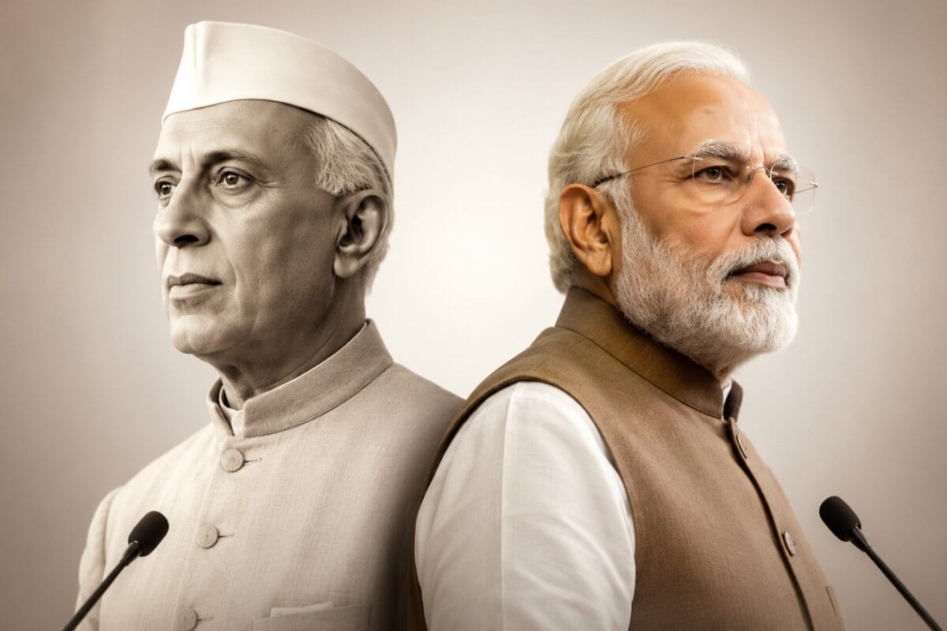
Had Nehru been a Nationalist, Or If Modi were the First One
A hypothetical ‘Twist’ to Nehru's 'Tryst with Destiny'
Mistaking it as some sort of an accolade by one of Modi’s so-called ‘andh bhakts’, the skeptics shouldn’t skip this for his mere presence in the subtitle. Whatever, as a matter of fact, the historical facts vindicate his choice for this hypothetical venture, rather than that of Netaji Bose or Sardar Patel. It’s true, contrary to propaganda, Netaji caused the British-exist from India, confirmed by none other than Clement Atlee, the one who led them out. But given the turbulence of that time, he was not destined to become Azad Hind’s first prime minister. As for Patel, the people’s choice for the premier position, instead of shouldering the nation at its most critical juncture, he catered to maverick Gandhi’s wicked whim, to put its fate in the ill-equipped hands of the fallible Nehru. So, that makes Modi, who proved himself as a nationalist to the core, in thoughts, words and deeds, as the right choice to man this piece, more so, as he just overtook Nehru’s uninterrupted stint as the country’s elected prime minister.
It is pertinent to note that in his 15 Aug 1947 midnight ‘Tryst with Destiny’ address to India’s constituent assembly, Nehru had stated at the very outset - “Long years ago, we made a tryst with destiny; and now the time comes when we shall redeem our pledge, not wholly or in full measure, but very substantially”. Well, for all intents and purposes, if it’s not an exhibition of his utter lack of ambition to lead India to its once-held preeminent position in the world, what else. Just contrast his limited thinking with Modi’s audacious vision of Vikasit Bharat and his energetic approach to realise that. So, hereunder is India’s hypothetical tryst with destiny, had Nehru been a nationalist, or if Modi were in his position as the first prime minister. [Emphasis supplied]
“Dear Bharatiya:
No denying that on this august occasion, though it is tempting to indulge in grandiose posturing, I would rather resort to plain speaking to outline my thoughtful vision for the eternal good of our new Bharat in the making.
I, for one, believe that there is no cause for celebrating our long-denied freedom for which we paid the price of partition, of our precious land. Besides, I dare say that we cannot remain oblivious to the fact that the spirit of our people, the soul of our karma bhoomi, came to be stymied under the alien regimens that lasted for a thousand years. Thus, at this historic juncture, as our resolve should be to lead our once-redoubtable country to the new frontiers of excellence, in the not-so-distant-future that is, so we must reckon this as a substantive moment, not a symbolic event.
Hence, it is incumbent upon us to apply our minds to nation-building, for which, first of all, we must, above all else, imbibe that spirit and induce it in the minds of our people, which Alberuni in 1030 CE characterised thus: "The Hindus believe that there is no country but theirs, no nation like theirs, no kings like theirs, no religion like theirs, no science like theirs." Thus, it is the onerous duty of all of us that happen to hold the positions of influence and power at this critical time, to reinvigorate that sense of pride in our people, with a resplendent past, distant though. So, let us all strive to create the Bharat Varsha of Swami Vivekananda’s dreams in which his Sanatani, garv se kaho hum hindu hai (proudly proclaim that we’re Hindus), refrain is on every lip.
No mistaking that for this ancient land has historically been the Hindustan, and if anything, with the creation of Pakistan for the Muslims, the India today is unequivocally Hindu, by its composition, culture, custom and character. Thus, for some delusionary applause from within and without, I see no point in singing paeans to the mythical ganga-jamni tehjeeb, which, anyway, the partition on the Hindu-Muslim fissures made fallacious. So, in the national interest, what is needed is a hard talk to deal with the ugly reality of the faith-driven Muslim disaffection of the Hindus, conceitedly called kafirs. Strangely though, having whole-heartedly subscribed to the Muslim League’s two nation theory, based on the premise of “Hindus and Muslims were two distinct nations with separate religions, cultures, and values”, over a third of the enthusiastic believers of the same, chose to remain in the Hindu India! Is it mere hypocrisy?
Whatever, it should not be lost on them that Hindus, having been forced to cede one-fourth of their land for a Muslim homeland, did not insist upon their repatriation to it but instead, hosted them in their midst. If anything, that Hindu gesture alone, in the normal human course, is cause enough for these Muslims to rescind their separatist mindset to become the emotional ingredient of our national character. But the hitch, as pinpointed by my erudite brother, Dr. BR Ambedkar, is that “Islam can never allow a true Muslim to adopt India as his motherland and regard a Hindu as his kith and kin”, and I’m certain that he would love to be proved wrong on both counts. More so, as the onus is on the Muslims to become worthy of the Hindu magnanimity, it pays them to realize that the prejudices of their alien faith render them into square pegs in the round holes of Bharat that is India. And for that, it’s essential for them to understand that the inimical content of their faith, shaped by the alien tribal mores of the dark ages, has become redundant in these altered times, more so in the multi-religious societies like ours.
However, lest the Muslims should feel singled out on the dogmatic front, we must caution the mistaken Christians that their urge to convert the vulnerable Hindus, ostensibly for their supposed salvation, is grossly injurious to Indian social harmony, national unity and demographic health. So, they would be well-advised to desist from their ill-founded evangelism for unlike the prophet-centric prejudices of their, and the other Semitic faiths, the philosophy of Sanatana dharma has evolved through the ages, by the sages. Whatever, it is a travesty of enlightenment in that these dogmatic Semitic orders, sans philosophy, sworn to outrageous diktats of their intolerant gods, should have at all gained their cultish grounds in our land of the Upanishads. Oh, how they visualized that it’s man, who created gods, not the other way round! It’s another matter though, sadly over time, the Sanatani wisdom gave way to the Hindu superstitions, resulting in India’s intellectual decline.
Be that as it may, we must admit that Hindus have to blame only themselves for the Semitic mess in their midst for they disregarded the Sanatana ethos of Vasudhaiva kutumbakam (holds world all in one household) to denigrate part of their ilk as lesser souls, and, what’ worse, branded some others as untouchables. Sadly, though understandably, that make them all the easy prey of the evangelist poachers, equipped with false religious assertations and fake social postulations. However, wonder why it doesn’t ever dawn on the proselytizers of either dispensation that the manner in which they go about luring the others into their lot, in essence, is a dubious way of spreading, what they propagate as a noble religion, or the God’s straight path, or whatever! However, it goes without saying that before demanding the adherents of the alien faiths to imbibe Bharatiyata, the Hindus themselves must bring their sidelined ilk into the Sanatana fold, in both letter and spirit.
Last but not the least is our onerous task to reweave our tattered moral fabric, which, once, as noted by ancient Chinese pilgrims, was ethically pure in an economically prosperous setting. Why, for that matter, even at the end of the rapacious Islamic regimes, the forerunners to the exploitative British colonial rule, our GDP was over one-fourth of the global one, which sadly stands at a meagre three percent of it now. Just the same, without delving too deep into the myriad causes of our moral decay and the economic decline, suffice it say that as corruption is the source of our social scourge that plagues our country in every which way, it can be affirmed without any contradiction that it is treason by another name. It’s thus, unravelling the well-entrenched graft from independent Bharat can only be our vande mataram in its true sense.
Just the same, the problem with a problem is that until one admits that it exists, one cannot address it, and unless it is addressed, it persists. So, let’s honestly confess the problems our country faces, and sincerely strive to evolve feasible solutions to effectively address the same, collectively that is. Given the impeccable pedigree and innate genius of Bharat, I’m quite certain that our people and their progeny, sooner than later, would scale it to the formidable heights, at which our progenitors once positioned it. So, it is with that conviction, I commend this occasion as the beginning of the end of a millennial eclipse for our nation to regain and retain its resplendence for all times to come. Let’s trust our people for that.
Vande mataram.”
Now, from the hypothetical nationalism, back to the ‘Tryst with Destiny’ of the “Englishman by education, Muslim by culture, and Hindu by birth” Nehru, propped up by Gandhi, lo, for being “the most English among us all”, for the comparative record. It’s no wonder then that in its editorial, ‘India: another tryst with destiny’, The Guardian of England, opined that “Today, 18 May 2014, may well go down in history as the day when Britain finally left India”, and that was the day when its 15th Lok Sabha was dissolved to make way for Narendra Damodardas Modi to be sworn in as its 14th Prime Minister later, on 26 May 2014.
And for record, the following is the rest of Nehru’s ‘tryst’:
“At the stroke of the midnight hour, when the world sleeps, India will awake to life and freedom. A moment comes, which comes but rarely in history, when we step out from the old to the new -- when an age ends, and when the soul of a nation, long suppressed, finds utterance. It is fitting that at this solemn moment we take the pledge of dedication to the service of India, and her people, and to the still larger cause of humanity.
At the dawn of history, India started on her unending quest, and trackless centuries are filled with her striving and the grandeur of her successes and her failures. Through good and ill fortune alike, she has never lost sight of that quest or forgotten the ideals which gave her strength. We end today a period of ill fortune and India discovers herself again.
The achievement we celebrate today is but a step, an opening of opportunity, to the greater triumphs and achievements that await us. Are we brave enough and wise enough to grasp this opportunity and accept the challenge of the future?
Freedom and power bring responsibility. That responsibility rests upon this assembly, a sovereign body representing the sovereign people of India. Before the birth of freedom, we have endured all the pains of labor, and our hearts are heavy with the memory of this sorrow. Some of those pains continue even now. Nevertheless, the past is over, and it is the future that beckons to us now.
That future is not one of ease or resting but of incessant striving so that we might fulfill the pledges we have so often taken and the one we shall take today. The service of India means the service of the millions who suffer. It means the ending of poverty and ignorance and disease and inequality of opportunity.
The ambition of the greatest man of our generation has been to wipe "every tear from every eye." That may be beyond us, but so long as there are tears and suffering, so long our work will not be over.
And so we have to labor and to work, and work hard, to -- to give reality to our dreams. Those dreams are for India, but they are also for the world, for all the nations and peoples are too closely knit together today for any one of them to imagine that it can live apart.
Peace has been said to be indivisible; so is freedom; so is prosperity now; and so also is disaster in this one world that can no longer be split into isolated fragments.
To the people of India, whose representatives we are, we make appeal to join us with faith and confidence in this great adventure. This is no time for petty and destructive criticism, no time for ill will or blaming others. We have to build the noble mansion of free India where all her children may dwell.”
Now, the rest is for your contemplation

The Secular Cure of India’s Semitic Cancer
Exhibiting an abnormal Abrahamic unity, the Christians and the Muslims, at odds with each other, the world over, combine themselves to jointly undermine the Sanatana dharma, aka Hinduism, in the Hindu-majority India. However, there’s nothing intriguing about that for both seek to expand their exclusivist religious footprints in the fertile fields of the populous republic with a political system that willy-nilly facilitates proselytization like nowhere else. Hence, so as to devise appropriate devices to tackle this Semitic menace that their chequered history makes them to suffer, even after their so-called independence, Hindus of the day need to delve into the cultish credos of these dogmatic faiths; especially given their unfettered demographic growths have cancerous consequences to the Indian body politic, in the not-so-distant future.
To start with, for both these desert faiths, it’s an article of faith that their mutually exclusivist dogmas, with intolerant streaks inherent to them, have universal applicability with unquestionable divinity – while Jesus asserted that “Whoever believes and is baptized will be saved, but whoever does not believe will be condemned”, the Azan affirms that “There is none worthy of worship except Allah”. That’s not all, for the Christians, the Hindus are heathens, needing to be redeemed as their deities are fake, deserve to be ditched. What’s worse, for the Muslims, they are infidels, condemned to die at their hands, and their females, the legitimate sexual targets, all for the glory of Allah, no less, which fallacy, lo, the Muslim women take to their hearts! Thus, the demographic growth, more so of the Muslim kind, has a psychopathic dimension to it that is detrimental, even to the free speech, the foundation of, the once Hindu-achieved, human excellence, now sought to be throttled by the Islamic fanaticism - gustakh-e-nabi ki ek hi saza, sar tan se juda (disrespect Muhammad and get beheaded). So, it should be really scary to imagine the horrific effects of the cancerous growth of these converted characters, who tend to despise their ancestral culture and become implacably hostile to its ancient people, to mindlessly uphold the delusional traits of these dogmatic faiths.
All the same, the goody-goody Hindus condescend to descend to these misfits, more so to the Islamic variety, attributing their religious bigotry as well as their social aggression to their lack of literacy and their economic backwardness, never mind their highly educated fidayeen and the well-heeled terrorists unerringly belie the falsity of their fantasy. But yet, these very Hindus look the other way as, of late, the Indian corporate portals have become the frontiers of love jihad to coerce the Hindu women into converting, what with the female faithful pimping for their male co-religionists. So, the scourge of these religious conversions is not so much about the depletion of the Hindu ranks but about the increment of the demented characters that already have become formidable. But strangely, the Hindu Islamapologists are not perturbed, at least not yet, neither by the converts’ calculated demographic spread nor by their hateful behavioural patterns, and, as can be seen, there is a habit, and history, to that.
Well, Alberuni in his Tarikh al-Hind, written around 1030 CE, noted that "The Hindus believe that there is no country but theirs, no nation like theirs, no kings like theirs, no religion like theirs, no science like theirs". That the Hindus then should have gloated about themselves in like fashion that too in the wake of Ghazani’s sack of Somnath, not to speak of Qasim’s conquest of the Sind, as early as 712 CE, which was 102 years after Muhammad had firmed up Islam, belies their delusional mindset that has been persistently prevalent ever since in its profusion! It is another matter though that none of the Hindu kings ever ventured to reclaim the Sind for their Hindustan, like the Christians, who around the same time, had initiated the Reconquista to liberate Spain from the clutches of the same Musalmans. If anything, it is the telling difference between the Hindus and the followers of the Semitic faiths that proved fatal to India over the centuries. Why, even now, there’s no dearth of the woolly Hindus, who assert that the Semitic conversion sprees pose no threat to the Sanatana Dharma for, after all, it survived the Islamic Mogul Rule and the Christian British Raj, together lasting over a millennium, never mind at the end of it all, they were forced to part with one fourth of their ancestral land for a homeland for Muslims, evocatively named Pakistan.
Be that as it may, the cruel joke of India’s partition, based on Jinnah’s assertion that “Hindus and Muslims were two distinct nations with separate religions, cultures, and values” was that, out of 95 million Muslims at that time, 35 million of them that is over one-third, staid put in India, owing in no small measure to the Muslim-minded Nehru’s Machiavellian goading, to become his dynastic vote-bank by way of their innate communal outlook. Needless to say, making good of the Islamic leeway provided to them by Nehru and his dynastic successors, in what was supposedly Hindu India after the partition, they have been ever at increasing their numbers, exponentially that is, to become some fourteen percent by now that is more than the partition-inducing thirteen percent. Though for all practical purposes, the Ghazwa-e-Hind of an Islamic dream may forever remain a pipe dream for them and the hoped-for second partition, is a geographically untenable proposition, yet in time, the Muslim demand could be to declare the de facto Muslim mohalls into de jure Islamic areas, with sharia and all, within the boundaries of the Secular India. And given the Mullah-nurtured kafir hatred the Quran inculcates in them, who knows, their jihadi zeal may, at length, turn these into Gaza strips to kill the Hindu infidels in the adjoining habitats, a la Israeli Oct 7.
Thankfully though, the Hindus are becoming increasingly alive to the overtly Muslim and the covertly Christian demographic overturns around them as reflected in the recent constitution of the ‘High-Level Committee on Demographic Change’, HLCDC for short, by the Modi-sarkar, to comprehensively assess the ‘abnormal population shifts caused by illegal immigration and other unnatural causes.’ But the moot point is how things have been allowed to come to this pass, and the answer lies, as seen above, in the Hindu lacking of Shatrubodh (enemy awareness), which concept is slowly gaining the ‘right’ ground now. That is despite Chandmal Chopra’s 1985 Writ Petition to the Calcutta High Court seeking a ban on the Quran for its vile ayats on kafirs, in the wake of which Sita Ram Goel came up with his book, Calcutta Quran Petition, a year later. That this author self-published Puppets of Faith: Theory of Communal Strife (A critical appraisal of Islamic faith, Indian polity ‘n more) in 2003, with seemingly none such in between, tells the Islam-naive story of the Hindu Semitic-unawareness.
Needless to say, the Quran Petition was dismissed then and same would be the case at any time in the future, unless India becomes a ‘dictatorial China’, politically, economically and militarily, to un-Islamize the Indian Muslims, as is the case with the Uyghur Muslims, without a whimper of a protest from the Islamic world. Whatever, it is true that since late sixties, assorted anti-conversion laws have been in force in various non-Congress ruled Indian states to restrict religious conversions carried out through ‘force, fraud, or inducement’, but to no avail as evidenced by the need to constitute the said high-level committee now. Nevertheless, it is seldom appreciated that religious propagation, read religious conversion, which the Indian Constitution naively treats as the citizens’ fundamental right, as detailed in the author’s article, Incongruities in Indian Constitution, per se, is a constitutional fraud perpetrated on the gullible Hindus.
Thus, it should be not lost on any that the Indian Constitution, crafted by the Macaulay-educated babus of that era and adopted by the politically correct netas, engaged in chasing the Gandhian mirage of Hindu-Muslim bhaichara in India’s ganga-jamni desert, is a cruel double whammy on the long-denied natives. That’s not all, even as the Hindu-apathetic Nehru laid its philosophical foundation, its ‘architect’, Dr. BR Ambedkar, who swore not to die as a Hindu, and indeed passed away as a converted Buddhist, built the tome that set the anti-Sanatana tone, which for long fell on the deaf Hindu ears. Now that the pro-Semitic constitutional tune is becoming increasingly irritable to the jaag utha (woken up) Hindus, by the year 2047, it may as well be the case of the good riddance of this bad rubbish, giving cause for India to celebrate its hundredth-year of independence then as Vikasit Bharat, in the true sense that is.
However, as the Semitic cancer has already reached the second stage, ably aided by the constitutional provisions and largely abetted by the Nehruvian policies, it is imperative that it should be adequately cured at this stage, without further delay at that, to prevent it from growing into the incurable fourth stage.
Here’s a prospective prescription for the same.
Rx
Diagnosed Semitic Stage II cancer in Indian body politic.
Recommended procedures for its containment and cure.
I) Preventive measures
In propagating one’s religion, faith or creed, the following actions are deemed contrary to ‘public order, morality and health’, paramount in the constitution, and as such are treated as criminal acts punishable with due imprisonment and an appropriate fine as well as life-long prohibition of the violators from indulging in any form of religious propagation/activity whatsoever.
i) Promoting one’s god, prophet, seer as the only valid god, prophet, seer, and picturing the gods, goddesses, dieters of other religions, faiths, creeds, customs as false, fake or inferior for denouncing or demeaning the latter.
ii) Positioning one’s religion, faith, covenant, creed, custom, convention as the only divinely true one and that the other religions, faiths, covenants, creeds, customs and conventions are false, fake or inferior.
iii) Asserting that one’s religion, faith, covenant, beliefs, customs, and conventions as superior to those of the others that lack the divine sanction / approval or are irrational.
iv) Highlighting only the palliative aspects of one’s religion, faith, covenant, custom and conventions, all the while hiding the regressive and obscurantic features and characteristics of the same in ways to make the prospective converts perceive that the other side of the fence is greener.
v) Luring the others into one’s religion or faith by theologically picturing the same as caste-free, contrary to its widespread prevalence among its converted peoples in the Indian social setting.
vi) Seducing the socially, educationally and economically weaker sections of people as well as the emotionally vulnerable ones, of other religions, faiths and communities, to enter into one’s religion or faith with financial inducements, fake promises, alleged miracles and such dubious tactics.
II) Curative methods
In professing and practicing one’s religion, the following are deemed contrary to ‘public order, morality and health’ and hence treated as criminal acts, punishable under the law.
i) No recitation, preaching, recounting, propagation of such verses or anecdotes from the holy scriptures, religious books, historical accounts that derogate other faiths and inculcate enmity towards the followers of the same, can be undertaken anywhere, even in religious places, under any circumstances whatsoever.
a) Any violation of the above by ordained priests, religious propagators, social commentators et al, entails imprisonment and fine besides a life-long ban on such to reassume the same or similar religious roles.
ii) No preaching, teaching, lecturing or discoursing, rooted in the religious scriptures, tenets, books or historical accounts in the educational institutions of any denomination that induce disregard, hatred, enmity etc. towards other religions/ faiths or their adherents should be resorted to.
a) Any violation of the above carries due imprisonment and permanent disablement of the involved teacher(s) from such an occupation.
b) Should any such institution continue to indulge in this prohibited practice with different characters, then that facility would be disbanded and the members of its board or committee, would be collectively and severally barred from establishing such or similar outfits to undertake such or similar activities for the rest of their lives.
Note – Seek a second opinion from HLCDC, just in case.
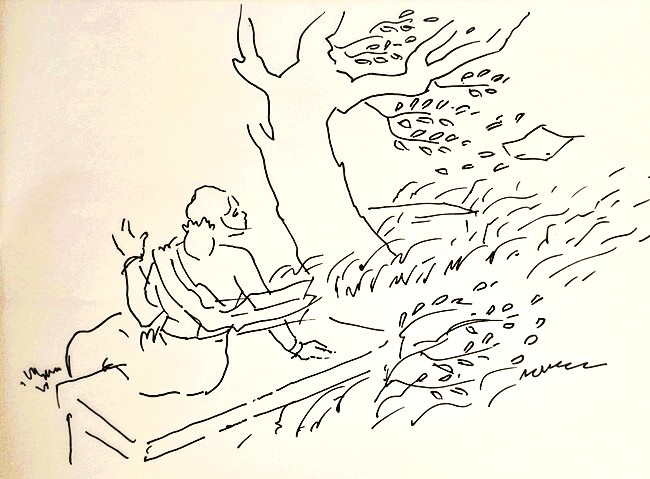
A Providential Encounter
This is a poignant story about the villainy of vanity exemplified by the lives of a middle-aged woman and a grey-haired man, involved in a providential encounter.
Stepping into a sprawling park nearby, Latha headed towards a lonely bench to sit on the horns of a dilemma. Soon, as if they got wind of her morose mood, the monsoon clouds began to engulf the setting sun to sync the environs with her gloomy demeanor. But yet, unmindful of her bereft state, the charm of her middle-aged form enlivened the surroundings, emanated by the eyes of the beholders. If anything, enhancing that sense of espial, the romantics among them envisioned her maiden frame entwining her man as an ever-eager creeper. All the same, lost in her thoughts, she was oblivious to the goings on around her enchanting presence.
However, as her mind began muddying her thoughts, she grasped the note she had tucked in her blouse, closer to her heart, and hardly had she pulled it out to review her plan of revenge, a gust of wind snatched it from her hands. Nonplussed though, she readily recovered her wits to pursue that ariel piece for its retrieval before it landed in alien hands. So, not losing sight of that self-incriminating thing, she ran with the wind till that dropped into a secluded portion of the park. Then, holding her breath for a while, she hurried her way into that nuke but upon seeing a semi-gray-haired man engrossed in going through her outpour, missing a heart a beat, she stopped in her tracks. However, gathering her wits in time and having weighed her options - reclamation or abandonment – she headed towards him.
“Excuse me, it’s mine,” she said embarrassedly pointing to her note that he began to pocket.
“How am I to know that it’s yours?” he said questioningly.
“You know that it’s not yours either,” she said argumentatively.
“True, but what if I were to put this damned idea into the wrong head,” he said without taking his eyes off her.
“I’m Latha,” she said lowering her face
“Have it,” he said handing it over to her.
“Thank you,” she said with a sigh of relief.
‘It’s Okay,’ he said thoughtfully.
‘Oh, what would he be thinking about me?’ she began to envision, leaving him hurriedly. ‘Whatever it is, what difference does that make for me? But isn’t something more in his stare than mere desire? Whatever it is, probably that could have held him back from befriending me. Could it be contempt for my character? So be it, but how do I care. Oh, no, he’s privy to my plan and could imperil me when the chips are down. What if I seduce him into becoming my accomplice? But looks like he’s too level-headed to get into a vulnerable position to compromise himself. So what, I’ve nothing more to lose by way of trying. Even otherwise, his semi-grey eminence is worth courting.’
Looking back over her shoulders and seeing his stare, she walked towards him.
“Sorry, I forgot to ask your name,” she said upon reaching him.
“Is it the cause of your comeback?” he said with a smirk on his face.
“What else do you think it could be?” she said making it evens stevens.
“So, you’re smart as well,” he said wearing his admiration for her on his sleeve.
“As well as what?” she said teasingly, pleased with herself.
“I’m Mohan,” he said invitingly.
“Thank you, Mr. Mohan, but that’s no reply for my query,” she said coyly.
“Well, but there’s no prelude for that?” he said expectantly.
“May I sit, as a prelude?” she said, slipping out of her slippers.
“Oh, I’m sorry for being unchivalrous,” he said, standing up.
“Maybe you’re overawed,” she said coquettishly as they sat together.
“Looks like you’re unnerved,” he said for a repartee.
“What rubbish?” she said mawkishly.
“Never mind, I’m no blackmailer,’ he said sincerely.
“Thank you for not making it worse for me,” she said suggestively.
“Now, you’re free to call it quits,” he said tentatively.
“But I’m not done yet,” she said seductively.
“With what?” he said anticipatively.
“I’ve another side of my ‘scandal sheet’ to show you,” she said enticingly.
“I suppose it’s a fair offer,” he said assuming an attentive posture.
She was barely thirty when her husband, a Major in the Indian Army, laid down his life in a counter-insurgency operation in Kashmir. So as to wholly devote herself to his ageing parents, to whom he was the only child, she gave up her schoolteacher job, and came to lead her life with them in the shadows of the martyr’s memories. However, after their death, in quick succession, to overcome her ennui, she took up teaching all again. That was five years back, when she turned forty. Soon, as it happened, she was drawn to a twenty something colleague that set up their passionate liaison in which she was on cloud nine all again. But ever since her lover, that was a week back, broke with her to get engaged with a young woman, she has been left gasping in the pit of despair.
“Why spare your boyfriend and spoil his betrothed?” he said in a manner of knowing the answer.
“I don’t want to lose him to her,” she said resolutely.
“Suppose you make it a perfect murder that’s rare any way, would it insulate him from another dame?” he said questioningly.
“I didn’t delve into all that,” she said confusedly.
“It’s the villainy vanity that failed you to figure it out,” he said thoughtfully.
“What do you mean by that?” she said in half-protest.
“If it were a case of love turned into hatred, you would’ve wanted to see his end but as he snubbed you for her sake, I suppose it’s your vanity that makes her the target of its hurt,” he said in a helpful tone.
“It’s possible,” she said after some contemplation.
“You’re sensible,” he said in a complimentary manner.
“But still your counselling helps,” she said invitingly.
“I’m not a psychologist,” he said evasively.
“But you seem so,” she said, and added, “if you care to tell me about yourself, I’m all eager to listen.”
“Evan as deeper thoughts tend to evade the radars of close relationships, how strange it is that our apprenticeship of acquaintance should begin with the exposure of our dark secrets,” he began stoically. “To begin with, though bright, being poor, I was down to earth but when a rich man’s attractive daughter married me for love, so to say, my ego got energized. But it’s her wifely devotion that gave birth to my manly vanity that is besides our smart son, who, in time, became a decorated cop. When we were in search of a suitable bride for him, the Naxals managed to get their nemesis to plunge us into gloom.”
“Oh, what a fateful coincidence!” she exclaimed, interrupting him.
“But as you would see, the effects of it varied widely,” he said as he resumed summarising his life. “Lo, living in my vanity world by then, in my son’s supreme sacrifice, I came to see my service to the nation as his father, furthering my illusion. Sadly, as my wife widowed me five years back, though I could overcome her loss in time, devoid of her adoration, I became a fish out of water. Not for long though as my hand of vanity led me to a poor lass of quality, whom, with my wealthy attentions, I enticed into marrying me. That was three years back, and ever since, people mistook her for my daughter, bolstering my vanity no end.”
At that, he paused even as she was listening wide-eyed.
“It’s thus, given my situation, I failed to fathom her feelings,” he began saying. “It’s only the other day that she made me privy to the villainy of my vanity that has been stymieing her, not so much in my bed but in her life, as she put it. Instead of wooing her with my wealth, had I won her with my affection, she might’ve fallen in love with me, never mind my grey hair. As the familiarity of the well-heeled living began waning the thrill of it, for long, she was yearning for a normal life with a man she loved. Asserting that she could bear it no more, she pleaded for separation from me without any encumbrance, and seeing her plight, as I had no heart to refuse, it didn’t take me long to accede to her request. Whatever, as a recompense, I even offered her enough money to last her life-time that she has flatly refused. So, after she moved out of my place this evening, as a prelude to divorce, I came here to take a serene look at the falsity of my vanity, and you know what followed.”
“Oh, how remarkable,” she said in awe and added, “you make me seem so small.”
“Why spoil me by stoking my vanity,” he said half in jest.
“Well, I will be failing myself if I don’t confess that I came back to you with the idea of seducing you into becoming my partner in crime,” she said shamefacedly.
“Blame it on the villainy of vanity,” he said patting her shoulder assuredly.
At that, pulling out the damning thing from her blouse and having shredded it into tiny pieces, she blew them away from her palm as if driving out vanity from her life itself.
“Will you let me be your life partner?” she said turning to him with an appealing look.
“See, it’s not wise to act on the rebound,” he said sounding caution.
“But isn’t it stupid to lose track of our providential encounter?” she said spiritedly.
“Do you think I’m a stupid?” he said suggestively.
“I would let the time decide,” she said mischievously.
“Who knows what life has in store for us,” he said philosophically.
“Isn’t it said that If hopes were dupes, fears may be liars,” she said in hope, extending her hand.
Then, as if not wanting to lose track of each other, hand in hand, they headed towards the exit.
Hindu Theocratic State – Canard of the Libtards
After the millennia grind under foreign yokes, first that of the Islamic invaders and then of the British colonizers, Bharat Varsha, the ancient land of the Hindus, regained its independence as India, albeit downsized by the latter by carving out Pakistan from it as a homeland for its Muslims. Thus, it would have been logical that the Hindus had the truncated India all for themselves but owing to its wooly political leadership, it was not to be, which forever constrains them to drink the same old wine in a new bottle. What’s worse was Nehru’s nipping the Hindu nationalistic impulses in the bud, perceiving them as offensive to the religious sentiments of the Muslim minority that made India merely a habitat for varied interest groups.
What with its Muslim progenation progressively becoming a formidable electoral vote-bank, Indian politicians of all hues, barring the right wing Bharatiya Janata Party (BJP for short), have been weary of nationalism that is anathema to Islam. By exploiting the Hindu caste divisions and exacerbating the Muslim identity crisis, the self-serving ruling classes had thrived all through by thwarting nationalism from occupying any political space. At last, though the BJP could raise nationalistic ripples through its Ayodhya movement towards the end of the last century, that it failed to turn them into sustainable electoral currents thereafter exemplifies the vice-like grip the secular parties, read vote-bank politics, came to have on Indian electorate. By the way, nothing symbolizes the Hindu plight in independent India than their inability even to make a case for the restoration of the venerated temples at Kashi and Madhura, vandalized by the Islamic invaders. What with the creation of Pakistan, as a separate homeland for Indian Muslims, it can be said that India’s Hindu-Muslim heritage no longer holds good - though Muslims want to have the Pakistani cake and eat the Indian one - and thus the Hindu retrieval of these shrines from the Muslim hands should not raise any secular hackles, should it? It was another matter though that restoration of the much vandalized Somnath temple owed more to Sardar Patel’s nationalistic push than any Hindu religious will.
However, the inexorable rise of Narendra Modi of the BJP in the Indian political arena after 2014 that too on the plank of Hindu nationalism, made the ‘politicians on the retreat’ to raise the bogey of a Hindu Theocratic State ‘in the making’, threatening the very idea of secular India, conceived by the founding fathers. While this clearly is a ploy of the entrenched politicians to stall the unmistakable voter-tilt against their brand of politics, the ideologically driven left-liberals, nay libtards, and Islamapologists - Islamapologia is condescending to descend to Muslims - together are disdainful of India’s governance by the so-called Hindu ‘fundamentalists’. If anything, the rise of the Islamic radicalism in the theocratic Muslim countries that became the breeding grounds for terrorism has come in handy for the libtards to come up with their ant-Hindu canards. So goes the argument that any revival of the Hindu fundamentalism, as if there was one in India’s long history, would likewise pave the way for a Pakistani India, with like consequences.
Be that as it may, what an irony that the Christian Islamapologists, who don’t shy away from exhibiting their Hindu allergy, fail to see that Muslims from the Islamic nations, once colonized by them, have begun to Islamize their own countries! Given the pace at which the ‘fastest growing religion’ is growing in Europe and in the Americas, it may not be long before their progeny would be cursing their ancestors for failing to Christianize their erstwhile Muslim colonies. That would also be when the much maligned Hindus gleefully watch the bikinis giving way to burkas, even as the beards grow longer and longer there. But more to the point, as Islam nips the inquiring mind in the bud, in time, the superiority of the western thought would be a thing of the past, as is the case with the once advanced cultures of Egypt and Mesopotamia. (Read ‘Islamic Assault ‘n Christian Retreat’ at this site)
Leaving the West to its self-destructive Islamapologian ways, a closer look at India would reveal how the fear of the Hindu Theocratic State is unfounded to say the least. True, the Islamic fundamentalism could usher in theocratic states in many Muslim countries owing to the religious fervour of the believers for the adoption of the oppressive sharia and other depressive Islamic laws that Islam enjoins them to abide by. But when it comes to Hinduism, there are no such religious ways that the Hindu masses crave to be the laws of the State to its detriment. In fact, it is the other way round as there have been umpteen reformative movements to eradicate the social ills that crept into the day to day Hindu life, such as the scourge of untouchability. Whatever positivity the Islamic and Christian presence in India there might have had was offset by the male chauvinism occasioned by the former and sexual prudery induced by the latter in the open Hindu ethos.
Back to the issue, the diversity of the Indian sub-nationalism, rooted in the vernacular affiliations, would provide enough hurdles and more for the alleged fundamentalists to rally Indians towards the Hindu Theocratic State. Moreover, in Arya Varta’s long history as Bharat Varsha, save Aurangzeb’s brief Muslim theocratic interregnum in its Hindustan era that too in parts, which the libtards push under their secular carpet, there never was a Hindu Theocratic State in its bosom. It was as it was, and as it would be, for the very concept of it is alien to the Hindu ethos, steeped in the tradition of liberalism from inception. Yet, a flashback into the colonial Indian history would reveal that it is when the Islamic sense of separateness took wings as the Muslim craving for a separate homeland for them that some farsighted Hindus like Savarkar, with the hindsight of history and a grasp of the Islamic ways, deemed it fit to wake up the Hindus from their suicidal stupor.
But by then, the Hindu society was beset with antagonistic caste divisions, sowed by the priestly interests through interpolations such as chāturvarnyam in the revered Bhagavad-Gita (more about that in “All about Interpolations” in the author’s Bhagvad-Gita: Treatise of Self-help, a free ebook in the public domain which were later exacerbated by the feudal order. So, it was imperative for Savarkar to first lay unity bridges across the caste divisions by defining the Hindu as “one who was born of Hindu parents and regarded India as his motherland as well as holy land” and then unite them on the Hindutva ground of “common nation, common race, and common culture of their ancient nation”. Besides, by proclaiming that “we Hindus are bound together not only by the tie of the love we bear to a common fatherland and by the common blood that courses through our veins and keeps our hearts throbbing and our affections warm, but also by the tie of the common homage we pay to our great civilization - our Hindu culture”, he sought to integrate them emotionally as well. However, owing to वसुधैव कुटुम्बकम् (vasudhaiva kutumbakam, world is one family) being the undying ethos of Sanātana dharma, he later remoulded Hindus as “those who consider India to be the land in which their ancestors lived, as well as the land in which their religion originated.”
In juxtaposition, fundamentalism is all about the perseverance with the dictates and the enforcement of the diktats in a given scripture based on the fundamental and unwavering belief of their inerrancy. It may be appreciated that for a theocratic state to come into being, it is essential that vast multitudes of the majority community should clamour for it as Muslims do for their Caliphate. Any informed analysis of the present day Hindu social structure and its religious practices will point out to the fact that the Hindu Theocratic State is incomprehensible even conceptually; leave alone the possibility of it ever becoming an Indian reality. However, on the flip side is the lack of the Hindu intellectual apathy for the antagonistic religiosity of the minorities - the Christian disdain for them as heathens and the Islamic dismissal of them as kafirs. Besides, how the laudable, though naïve, ‘world is one family’ outlook has been stretched to ludicrous lengths is testified by the way the alien faiths were allowed in Hindustan, over a millennium, to unceasingly expand their demographic ground through calculative conversion and progenation, without let or hindrance.
It’s thus the history of Hindustan had thrust a multi-faith feather on the Hindu egalitarian cap though letting the Muslims and the Christians to wear their exuberant religious colours. And that proved fatal as Muslims, after having shared the land of the Hindus for centuries, yet began to demand a homeland for them, which in effect means that they don’t deem anything as their own unless fully owned by them. And true to their intent and character, once the British gave them Pakistan, they were ever at getting rid of the Hindus from it, which should be an eye-opener for the libtards. But yet, maybe fearful of being branded as Islamaphobes, they tend to be indulgent to the Muslim penchant to carve out exclusive Islamic enclaves in India, be it in Kashmir, Assam, West Bengal, or wherever they are in numbers. (By the way, Islamapologia is about condescending to descend to the Musalmans) What’s worse, they not only cry hoarse over the Hindu resentment over the Muslim demographic designs but also preach the virtues of religious tolerance, a constitutional obligation at that, to Hindus! (Read Incongruities in Indian Constitution - A Summation at this site) Lo, it’s akin to the devil quoting the scriptures that is the good quotes for there are many a devilish one therein. Its ditto with evangelicals who are ever at reaping the ‘great harvest of faith’ in the Hindu hinterland and that gladdens Western hearts to pick up the libtard cues to badmouth the Hindus the world over.
So be it, but the Encyclopedia Britannica describes “Hindutva ('Hindu-ness'), as an ideology that sought to define Indian culture in terms of Hindu values" and India’s Apex Court had ruled that “Ordinarily, Hindutva is understood as a way of life or a state of mind and is not to be equated with or understood as religious Hindu fundamentalism ...”. However, it can be said that their lordships erred in assuming that there is something called Hindu fundamentalism, religious or cultural, for the Oxford Dictionary states that “fundamentalism is strict maintenance of ancient or fundamental doctrines of any religion, esp. Islam.”
I rest my argument by quoting from my Puppets of Faith: Theory of Communal Strife, also in the public domain as free ebook - “The Hindu fundamentalism is a misnomer, coined by the cunning and subscribed by the naïve, which had come in handy to the Semitic proselytizers to undermine the Indian nationalism. Why, it should be apparent to the discerning that while the Brahmanism is orthodox, the sanatana dharma, exemplified by swadharma, is amorphous, and in them lay the social diversity of the Hindu spiritual ethos.”

Semitic Censure Of Sanatana Dharma, Or The Pot Calling The Kettle Black
Unmindful of the old adage, when you point a finger at someone else, there are three pointing back to you, Udhayanidhi, the Christian son of the atheist Chief Minister of Tamil Nadu, MK Stalin and his devout Hindu wife, had raged an unseemly controversy through his clarion call for the eradication of sanatana dharma aka Hinduism that he likened to dengue, malaria and corona. It is another matter though that he has no issues with the ethics of the Christianity that required him to get baptized into its fold to wed his believing beloved. Be that as it may, his closet Christian party colleague A. Raja pitched in with AIDS and leprosy tags to picture Hinduism as a menace to the world at large for it is a synonym of casteism. But who were to ask the Indian Church as to why it won’t deem encouraging Crypto-Christianity, which is the secret practice of Christianity, in places and time periods where Christians were persecuted or Christianity was outlawed, as a fraud in the secular Bharat, whose constitution naively grants its citizens, read Christians and Muslims, the right to propagate their faith, which is but the license to convert the gullible Hindus. Likewise, who were to question the morality of the closet Christians, who allegedly follow the teaching of Jesus and yet have no compunction in hiding their changed faith to fool the public and deceive the State to derive undue benefits to gain illegally? That the Church is hands in glove with this duplicitous evangelical ways is of no credit either to their God or His Son is somehow lost on the born-again Christians as well as the eager converts. In so far as the caste in the Christianity is concerned, the segregated Churches stand tall to testify the same. That being the Indian Christian reality, there’s no gainsaying for the dalits to embrace the alien faith on the sly but yet the onus is on the Hindu samaaj to make them feel at home in the Sanatana tent.
However, the Hindu intellectual response to the malicious Semitic attack on their dharmic ethos was stymied for the caste has always been the Achilles heel of their social chore. Hence, it is imperative to probe the Hindu social ills and delve into the Church’s religious ill-wills so as to bring the lopsided discourse onto an even keel. It may be noted that even as narō nārayana (man is but God) is the integral maxim of sanatana dharma, the Christian credo suffers no qualms about the inhuman slavery as averred in the Bible (1 Peter 2.18) – “Slaves, be subject to your masters with all reverence, not only to those who are good and equitable but also to those who are perverse” and such. Also, whereas Hinduism espouses the eclectic concept of ekam sadviprā bahudhā vadanti (what is right is One only, describe it wise variedly), the Church holds the narrow view that only faith in Jesus portends salvation and the choice against him results in eternal doom. That’s not all, while sanatana dharma postulates vasudhaiva kutumbakam (holds world all in one household) in the Christian scheme of things, all non-Semites are heathens; if anything Islam debunks all other faiths, Christianity included, and vilifies all non-Muslims, not exempting the Christians, as kafirs destined to eternally burn in the hell of a hell.
It’s no wonder thus, in the times of yore, while the Hindus soft-sold their eclectic dharma for the greater good of the mankind, the my way or the high way Christianity, averred Edward Gibbon, ‘was the harbinger of the destabilization of the religious harmony of the ancient world, achieved by the facility with which the most different and even hostile nations embraced, or at least respected, each other’s superstitions’. If anything, the Muslims made it worse in medieval times by thrusting their even more intolerant Islamic dogma on much of the then hapless world. However, the irony of the Abrahamic religions is that whereas their common God freed the Jews, his chosen people, from slavery of the Pharaohs, the followers of His Christian Son and the believers in His Islamic Messenger came to enslave the conquered peoples besides commoditizing them for the slave market! That apart, if only these convert-censurers of sanatana dharma were to be mindful of the Christian treatment of the Black Americans well into middle of the last century besides the prevalence of the Jewish hatred, the racial abuse and the religious atrocities in the Christian as well as the Islamic societies, they would have probably held their vicious tongues in their cheeks and desisted from spewing religious venom against the dharma of their forebears.
Whatever, the Hindu social aberration that is the abhorrent dalit slight was never as dehumanizing as the Abrahamic slavery, and thus the ranting of Udhayanidhi & Co to eradicate the sanatana dharma is akin to the Semitic pot calling the Hindu kettle black. Just the same, there is a cynical method in the Semitic madness to deride Hinduism and that is to turn the disgruntled Hindu castes into an evangelic feed to try to fulfill the fond hope of Pope John Paul II expressed in New Delhi in November 1999, “may the third Christian Millennium witness a great harvest of faith on this vast and vital continent”. If anything, and despite the Papal threat to their national interests, first the Hindu cadres of the Congress party followed by the sanatana voters naively vested, for two decades or so, the political power in the Christian hands of Sonia Gandhi, who unabashedly gave a fillip to his evangelical agenda like never before to try to disturb Bharat’s demographic balance.
However as Bharat’s destiny would have it, in 2014, when the reign of power passed onto Narendra Modi, the Hindu nationalist, he slowly but steadily reined in the non-governmental organizations engaged in surreptitious conversion programs facilitated by the Western Christian entities through illegal monetary support for the same. That apart, the introduction of the anti-conversion laws by his party-ruled States to check fraudulent conversions, and more so, the increasing Hindu awareness of the Semitic threat to their demographic order, have begun to pique the crypto and the closet Christians to the hilt. But this is only half an anti-evangelical measure and the tougher half lies in Hindus themselves admitting the inequalities in the caste order and redressing the same.
Well, to begin with, it is inconceivable that sanatana dharma with narō nārayana (man is but God) ethos would have conceptualized the exalted uchch and untouchable neech amongst men, and yet this abominable disparity had become the caste reality of the Hindu polity, the why, how, and when of which is rarely analyzed and hardly researched. What is worse is the Hindu hypocrisy which proclaims that in fact caste is not about birth but is all about one’s guna (character) or that all are Shudras at birth and it is guna that enables one to become a Brahmin, a Kshatriya, or a Vysya, as the case may be. While this absurd ‘Shudras at birth’ thesis belies the naivety of the savarna minds, the alleged guna-aided ascent on the caste ladder exhibits their intellectual dishonesty but for which Dr. BR Ambedkar would have been anointed as Brahmarshi by them. Whatever, as such homilies to humour the disgruntled dalits have come to naught, it is imperative that a level playing caste ground is provided to alleviate their justifiable bitterness.
In this regard, it is worth noting that in the early 11th Century as Al-Beruni noticed, the Vysyas the agriculturist-traders and Shudras the artisan-labour force lived in the same quarters, which happenstance underscores that the varna vyavastha of yore was not that caste-tight after all. But sadly, so it seems, at some point thereafter, Shudras, based on their respective occupations, came to sub-divide themselves into numerous caste groups in what can be called vruththi vyavastha, an imitation of the hierarchical varna vyavastha, which not only relegated the dalits to the lower rungs of the caste-ladder but also pushed their habitats to the village fringes. Needless to say, the genesis of this inimical sectarianism that facilitated the fruition of the alien Islamic and the Christian dogmas by way of conversion of the marginalized Hindu sections beg for a robust academic research and a wider public debate to understand our chequered history.
There is yet another dimension to the Shudric antagonism and that is the scriptural distortions brought about by inane interpolations in Purusha Sukta and Bhagvad-Gita that are highlighted in the author’s free e-book ‘Inane Interpolations in Bhagvad-Gita (An Invocation for their Revocation)’ available in the internet that is besides the much maligned Manu Smriti, unfairly though, as brought out in his essay ‘On Bashing Manu Smriti, Or Flogging A Dead Horse Riding A Blind Ass’ that can be Googled for reading. Last but not the least, as for the embittered Hindu souls, they may realize that their true path to salvation is not becoming Crypto-Christians but through their social ‘Dalit as Deva - à la Black is Beautiful’ assertion, accessible through the net.

Have Hindus Become More Intolerant, Or less Indulgent?
When the Semitic free run on the Hindu turf under Sonia’s proxy watch ended with the ascent of Narendra Modi onto the Delhi gaddi, the Indian agendas of the Christian west and the Muslim umma faced impediments resulting in the brouhaha over the growing religious intolerance of Hindus towards India’s minorities. Given the racial biases and the religious prejudices of both against the Hindus and that the world media, by and large is controlled by them, a critical appraisal of their propaganda with objective lenses is called for.
Hence, as the accusation is on the religious ground, it is imperative that the theocratic credos of Islam and Christianity as well as the philosophical ethos of santana dharma aka Hinduism, the only surviving ‘way of life’ of yore on earth, are to be reckoned with.
The pristine precepts of Hinduism are -
Narō Nārayana
Man is but God,
Vasudhaiva kutumbakam
Holds world all in one household, and
ekam sadviprā bahudhā vadanti.
What is right is One only, describe it wise variedly.
However, in time, as the broad ‘man is but God’ became the narrow ‘caste is the creed’, the so-called Hindu upper castes, so as not to suffer all and sundry, turned head on the unifying ‘holds world all in One household’ into the divisive ‘sunder castes men on earth’. What is worse, they managed to push the so-called lower castes into untouchable dalit ghettos on the peripheries, and far away from temples of their gods.
It was into such an Indian setting that the Muslim vandals, spurred by the Quranic credo of loot and rapine, made their way to render it unto Islam. However, setting aside the Muslim penchant to force the conquered populace into their alien faith, for the most part, the craving of the deprived-of-god dalits for a religious hold that could have furthered their Islamic cause to convert. Nevertheless, the self-absorbed upper caste Hindus were indifferent to the socially inimical development that began to upset the demographics of their ancient land even as the progeny of the converted began to imbibe the ethos of Islam that underscores their inseparable separateness from the non-believers that is besides inculcating hatred towards them with Quranic diktats such as –
“Your friend can be only Allah: and His messenger and those who believe, who establish worship and pay the poor due, and bow down (in prayer).”
“O ye who believe! Take not the Jews and Christians for friends. They are friends one to another. He among you who taketh them for friends is (one) of them. Lo! Allah guideth not wrongdoing folk.”
“Let not the believers take disbelievers for their friends in preference to believers. Whoso doeth that hath no connection with Allah unless (it be) that ye but guard yourselves against them, taking (as it were) security. Allah biddeth you beware (only) of Himself. Unto Allah is the journeying.”
“Those who believe do battle for the cause of Allah; and those who disbelieve do battle for the cause of idols. So fight the minions of the devil. Lo! the devil’s strategy is very weak.”
“Relent not in pursuit of enemy, If ye are suffering, lo! They suffer even as ye suffer and ye hope from Allah that for which they cannot hope. Allah is ever Knower, Wise.”
“It is not for any Prophet to have captives until he hath made slaughter in the land. Ye desire the lure of this world and Allah desireth (for you) the Hereafter, and Allah is Mighty Wise.”
However, the haughty upper caste Hindus, who according to Alberuni thought ‘there is no country but theirs, no nation like theirs, no kings like theirs, no religion like theirs, no science like theirs”, never deemed fit to grasp the nitty-gritty of the alien faith and instead could have falsely assumed that it would be but a benign variant of their own dharma, ‘what is right is One only, describe it wise variedly’, and thus saw no need to contain its growth in their midst for which their progeny paid the Islamic price in the form of Pakistan a millennium later.
In that setting, while the upper caste Hindus, who dismissed the Islamic invaders as mlechchas, also derided the converts as katuas, owing to their circumcision that their new faith ordained, the new-found religious aggressiveness of the latter coupled with their age-old social grievance could have ensconced them in an impotent rage. However, the fact that the intruders happened to lord over their erstwhile oppressors would have afforded some vicarious pleasure to the Indian Musalmans. Yet, in a remarkable social intercourse, the newly minted Muslims that gloated over the reflected glory of the new rulers and the upper caste Hindus, who laid store on their perceived superiority over all others, managed to live together tenuously though, which, in later days, the left-liberals came to romantically falsify as ganga jamuna tahjeeb.
Then, when the eight-hundred years old Islamic semi-dominance over India was on the wane, the Christianity spread its religious wings under the aegis of the British Raj, ostensibly to reform the Hindu heathens that the Bible holds in utter contempt in psalms such as -
“Ask of me, and I shall give thee the heathen for thine inheritance, and the uttermost parts of the earth for thy possession.” 2:8
“Thou shalt break them with a rod of iron; thou shalt dash them in pieces like a potter's vessel.” 2:9
“Thou hast rebuked the heathen, thou hast destroyed the wicked, thou hast put out their name for ever and ever.” 9:5
“Thou hast given us like sheep [appointed] for meat; and hast scattered us among the heathen.” 44:11
“But thou, O LORD, shalt laugh at them; thou shalt have all the heathen in derision.” 59:8
“Pour out thy wrath upon the heathen that have not known thee, and upon the kingdoms that have not called upon thy name.” 79:6
So, starting from the dalit bastis, the evangelists forayed further into the tribal tandas to spread Christianity by means fair and foul. However, as their catchment areas were peripheral to the Brahmin agraharas and the upper caste quarters, the Christian demographic alarm failed to wake them up from their slumber of indifference though unyoked from the Islamic hegemony by then. And to make matters were for them, Macaulay came up with his Minute on Indian Education, which, among other things was aimed to divest the Hindus from their “false history, false astronomy, false medicine, in company with their false religion” with the right western education.
However, while the Musalmans, fearing that the western education would lead to the dilution of Islamic faith among their wards, avoided Macaulay like a plague, the Hindus embraced him willy-nilly giving up their ‘haughty’ indifference to other faiths end ending up with ‘naive’ indulgence towards them. What is worse, from the Hindu point of view, the Macaulay education, over time, succeeded in making them have a dim view of the sanatana dharma of their progenitors and skeptical about all things Hindu be it its history, astronomy, medicine, culture etc. If anything, Gandhi in later years, to put it in the Hindi phase, turned out to be Macaulay’s baap, for he professed that “Hindus should not harbour anger in their hearts against Muslims even if the latter wanted to destroy them. Even if the Muslims want to kill us all we should face death bravely. If they established their rule after killing Hindus we would be ushering in a new world by sacrificing our lives.” But it was Nehru, who symbolized the fruition of the Macaulay mission for he not only proclaimed that “I’m English by education, a Muslim by culture, just born a Hindu by accident” but also conducted himself accordingly.
It’s thus, when it came to choosing the first Prime Minister of what is left of India after Jinnah had parted with parts of its land to establish Pakistan for the Musalmans, it’s no mere coincidence that Gandhi threw his heavy weight behind the Muslim-oriented Nehru and against the Hindu-minded Patel. Immediately thereafter, true to his character, Nehru strained every nerve to ensure that the Indian Musalmans did not migrate in numbers to Pakistan though the raison d'être of India’s partition was their assertion that they cannot co-exist with the Hindus. What is worse, he was allergic to the persecuted Hindu refugees from the then East Pakistan and even wanted them to be pushed back into it never mind their annihilation by the Bengali Musalmans therein, so to say, to put Gandhi’s preaching into practice. In the light of the above, and his reported obeisance, besides that of his daughter Indira and his great-grandson Rahul, to the Islamic invader Babur’s grave in Afghanistan, should be seen the conjecture that his own grandfather was a Musalman with Nehru nom de guerre.
Hence, it could not have been a mere coincidence that Nehru placed Hindu India’s educational reins in the hands of Maulana Abul Kalam Azad, who publicly voiced his fears that post-partition, the Muslim minority in the Hindu majority India would be disadvantaged. So, so to say, during his decade-long helm at India’s ‘secular’ education, the clever Maulana succeeded in making it seem to the vulnerable Hindu minds that the Muslim rule over their ancient land was but a natural Islamic course all the while downplaying their ancestral resistance to the same. Neither is the fact that four more Musalmans, all appointed by either by Nehru or Indira, reigned supreme in the corridors of Indian education for about nine more years, all of which was during the first thirty years after India’s independence, could be more than mere coincidence. It’s no wonder the Hindus who adorned that office in between these worthies or those that came later dared not alter the Nehruvian educational course set by the Islamic credo that insensibly became the non-violable creed of the Indian school curriculum till date.
It was in this continuing Hindu tragic play, Indira leased the academic stage to the Hindu-allergic and Islamapologic leftists in lieu of their political props, to let them shape and sustain the Hindu-inimical narrative for over five decades. Thus with the State’s patronage, the dubious leftists by adding the deceitful liberal suffix, managed to spread their anti-Hindu tentacles into every sphere of intellectual activity with impunity, thereby unerringly shaping an inalienable idea of India in which the Islamo-Christian communalism is deemed as secular and Hindu cultural assertion is regarded as communal. This obnoxious narrative on one hand gave fillip to Muslim separateness, displayed by skullcaps, even on kids’ heads, and on the other, fuelled the Christian urge to harvest the dalit and the tribal souls for the cause of Jesus, and any Hindu concern on either count came to be derided as religious intolerance. It was as if the Hindu feelings didn’t count in their own country, even after its partition on religious grounds, and when their pent-up anger erupted in Ramajanma Bhoomi movement resulting in the hot-headed demolition of the Babri Masjid, built over Ayodhya’s Ram Mandir in Babur’s time, the left-liberal ecosystem ensured that the entire Hindu community was engulfed in secular shame.
However, ten years later, when a Muslim mob at Godhra torched alive fifty-two Hindu pilgrims returning from Ayodhya to their native places in that Sabarmati Express resulting in the retaliatory rioting in Gujarat, even as the Mullahs tuned in “Islam is a religion of peace”, the Muslim intelligentsia proclaimed the growing Hindu communalism as the bane of secular India, of course to the nodding Islam naïve Hindu heads. It was this Hindu intellectual apathy that failed to produce even a single book on Islam in thousand years of its Indian presence (save Ambedkar’s stray, though incisive, thoughts on Islam and not counting Chamupati Lal’s thirty-four page Hindi booklet, Rangeela Rasool, published anonymously though, some hundred years before then that is available even now in the internet, which, anyway, was only about Muhammad’s unbridled libido that too as a retort to some Muslim derogatory writings in the form of Krishna teri geeta jalani padegi and Uniseevi sadi ka maharshi) that prompted this writer, innately a novelist, to come up his Puppets of Faith: Theory of Communal Strife ( A Critical appraisal of Islamic faith, Indian polity ‘n More).
While Rajpal Malhotra, the publisher of Rangeela Rasool, was murdered by a teenaged Musalman in 1929, there were no takers for Puppets of Faith in 2003, even as the rejection slip sent by one desi publisher is a giveaway.
I enjoyed reading the book. But I suggest you read Dr. Zakaria’s “Communal Rage in Secular India”. Your book is a bit Strident and could prove dangerous in wrong hands (Hindu fundamentalist).
What is to be noted is the Muslim communal grip on the Hindu secular mind, though it is another matter that this writer’s work has been in the public domain as free ebook for long without either raising Islamic hackles or fuelling Hindu fundamentalism, if ever there was.
It was in that Indian setting, the Italian Sonia could catapult herself into such a political position to be able to direct its administrative course to further the Christian evangelical drive, to fuel the Islamic fundamentalism and to demean Hinduism as saffron terrorism. No wonder that the Christian democracies and the Muslim autocracies alike toasted her decade-long proxy rule as the golden period of religious tolerance in the annals of the Indian Republic. But for the media coverage of her unbridled avarice and the idiocy of her heir apparent, she might have had her Hindu-inimical way in India for some more time but then as karma caught up with her in the Hindus’ karma bhoomi, she was busted at the hustings by Narendra Modi, who managed to stir the nationalistic feelings among the Hindus like none before him.
However, the advent of Modi on India’s political firmament coincided with the spread of internet therein that began to reveal unflattering facets of Gandhi and Nehru and the outraged Hindus lost no time in circulating the same through the emerging social media thereby taking away much of the sheen from these two, whom the Hindu-inimical ecosystem made into demigods. But more significantly, as the nationalist Modi’s ascent to the throne uplifted the Hindu morale as never before, some enterprising began to tackle the tailor-made Indian history to serve the Nehru dynasty’s political interests to lay bare its falsities before the public through their publications, if anything more effectively in their talk shows in the TV channels as well as in the social media platforms that came to abound. The net result of it all is that the Hindus have become more aware of the intolerant Islamic credo and the subversive evangelical creed that were together downplayed by the Nehruvian left-liberal kabal thus far, and so became less indulgent towards both, which is galling to the Hindu-inimical forces within and without that have come to orchestrate the chorus of India’s religious intolerance.
Be that as it may, Narendra Modi, on whom the resurgent Hindu multitudes pin their hopes to blind the Semitic demographic eyes that are cast on India, while going about it must take cognizance of Niccolo Machiavelli’s following advice in The Prince.
“So it should be noted that when he seizes a state the new ruler ought to determine all the injuries that he will need to inflict. He should inflict them once for all, and not have to renew them every day, and in that way he will be able to set men’s minds at rest and win them over to him when he confers benefits. Whoever acts otherwise, either through timidity or bad advice, is always forced to have the knife ready in his hand and he can never depend on his subjects because they, suffering fresh and continuous violence, can never feel secure with regard to him. Violence should be inflicted once for all; people will then forget what it tastes like and so be less resentful. Benefits should be conferred gradually; and in that way they will taste better. Above all, a prince should live with his subjects in such a way that no development, either favourable or adverse, makes him vary his conduct.”
So, Modi must inflict some secular injuries on the communal minded Muslims and the Christians on the ground that -
i) Muslims aver that all non-Muslims are kafirs and the Christians assert that Hindus are heathens, which flies in the face of the secular dictum that all men are equal.
ii) When all men are equal, as their gods cannot be unequal, the proclamation by Muslims in the Azan that There is none worthy of worship except Allah and the Christian propagation of Jesus’ words, “I am the Way, and the truth, and the Life; no one comes to the Father, but through Me” (John 14:6), are alike untenable.
iii) What is worse, while Muslims inculcate hatred in the believers against kafirs in the masjids, they let the religious education in the madrasas poison the minds of their youth to perpetuate hatred against the others in their umma, the Christian evangelists falsely propagate that the Hindu gods and deities are false, both of which are detrimental to the communal harmony in our country.
iv) The Muslim goal to usher in Ghazwa-e-Hind by Islamizing India through their unbridled procreation coupled with the illegal Islamist infiltration into it, and the evangelical agenda to bring all Hindus into the Christian fold are at odds with the preservation of India’s sovereignty and integrity.
Hence,
a) The Article 25 of the Indian Constitution that guarantees the freedom of conscience, the freedom to profess, practice and propagate religion to all citizens should be amended to desist any from propagating their religion though they are free to profess and practice the same. (Read the chapter ‘Constitutional Amnesia’ in Puppets of Faith: Theory of Communal Strife cited above)
b) All should be prohibited from making divisive suggestions such as, There is none worthy of worship except Allah, Hindu gods and deities are false, salivation is possible only through belief in the Christ, at the pain of imprisonment, punitive fines, and /or both.
c) The propagation that non-Muslims are kafirs and the Hindus are heathens, both destined to hell, should be prohibited at the pain of imprisonment, punitive fines, and /or both.
d) Madrasas, under the guise of religious education, should not be allowed to inculcate hatred in its pupils towards other faiths and their followers and masjids should be barred from doing the same through divisive sermons at the pain of their closure (now there’s the French precedent), imprisonment of its mullahs and punitive fines.
e) All religious exhortations or encouragement for unwarranted population expansion in any community with the intent to upset the existing demographic balance of the Indian polity should be prohibited at the pain of imprisonment, punitive fines, and /or both.
f) All religious personal laws should be invalidated by the Uniform Civil Code for the whole of India.
g) Last but not the least, the Bangladeshi Muslim intruders should be disenfranchised to begin with and to be deported eventually, if need be by coercing Bangladesh to have them back.
Modi may appreciate that while Raj dharma of sanatana dhanrma - ahimsa paramo dharmaha / dharma himsa thadhaiva cha (nonpareil is non-violence / nonetheless is righteous outrage) ordains him to take recourse to the above measures to avert India’s second partition down the line for the Quran that made Musalmans press for the first partition because they cannot co-exist with the Hindus would remain the same (it’s another matter though that they have become the most pampered lot in India), his political acumen should prompt him into ushering in comprehensive legislative and administrative measures some six months or so before the 2024 parliamentary polls, so that his possible return to power then would be deemed as the public endorsement of the same, once and for all, to silence and all.
Needless to say, it may not be lost on Modi that knowingly or unknowingly, he had been following Machiavelli’s second advice - benefits should be conferred gradually; and in that way they will taste better – for the benefit of his party, and so he can disregard the first dictum of the political genius only at the cost of India’s ruin.
Gagging Godse – A Ploy
Adolf Hitler had on his hands the blood of six million gas-chambered Jews besides fifty million soldiers, in the flower of their youth, and thirty million civilians of all ages, who perished in the World War II that he started, but yet he is among the most debated about worldwide. Moreover, Mein Kampf, his autobiography with an anti-Semitic slant is not ostracized either by the book world, but in a stark contrast, uttering the very name of Nathuram Godse, the man who assassinated Gandhi, a frail seventy-eight-year old man, and paid the price for his crime on the gallows, just running forty, remains a taboo in his own country for whose good he believed he did what he did, seemingly into eternity! So, sadly for him, the reality his legacy faces belies his hope, expressed in his ‘Why I killed Gandhi’ testimony; “I have no doubt that honest writers of history will weigh my act and find the true value thereof some day in future.”
It is one of the ironies of human history that Hitler, who restored to Germany the pride the Treaty of Versailles robbed if off, and Gandhi, who inspired India to free itself from the British yoke, should’ve become the bane of their countries in the long run. Though Germany could recover its Hitler trauma in time, it couldn’t repair its demographic dent the war had left to its hurt, but trapped in a Gandhi matrix mired by Godse conundrum, India is stymied, seemingly forever, from inculcating a nationalistic pride and purpose to achieve its true potential.
Godse, in his own words, was “Born in a devotional Brahmin family, I instinctively came to revere Hindu religion, Hindu history and Hindu culture. I had, therefore, been intensely proud of Hinduism as a whole. As I grew up I developed a tendency to free thinking unfettered by any superstitious allegiance to any isms, political or religious. That is why I worked actively for the eradication of untouchability and the caste system based on birth alone,” and that should have earned him a place of honour in the pantheon of India’s social reformers. Thus, but for a quirk of fate, maybe, Godse would have rubbed ‘reformist’ shoulders with Gandhi whom he had assassinated for altruistic reasons.
What had put him in the dock that led him to the gallows, again in his words, “I took courage in both my hands and I did fire the shots at Gandhiji on 30th January 1948, on the prayer-grounds of Birla House. I do say that my shots were fired at the person whose policy and action had brought rack and ruin and destruction to millions of Hindus. There was no legal machinery by which such an offender could be brought to book and for this reason I fired those fatal shots. I bear no ill will towards anyone individually but I do say that I had no respect for the present government owing to their policy which was unfairly favourable towards the Muslims. But at the same time I could clearly see that the policy was entirely due to the presence of Gandhi.”
Being himself a Hindu that Gandhi tended to be ‘unfairly favourable towards the Muslims’ at every turn to the hurt and humiliation of his co-religionists is a matter of common knowledge but the motivating factors of this unnatural tendency would’ve stemmed from his vanity to sustain the false aura of a ‘Mahatma’ that the vulgar minds had built around his fallible persona, lo, when he was in his mid-forties! Having seen Gandhi’s ‘image-need’ to bend over backwards to be ‘unfairly favourable to Muslims’ in the socio-religious as well as political spheres, Jinnah had exploited his ‘mahatman’ fallibility to the hilt and walked away with Pakistan to the hurt and humiliation of the Hindu majority of Hindustan. That Gandhi could not shed his inappropriate partiality towards those Muslims, who opted to stay put in the remainder of the sundered Hindustan, notwithstanding their unremitting aggression against his co-religionists therein, illustrates the power of vanity to blind one to the realities of life and times, which, so to say, proved to be the proverbial ‘last straw on the camel’s back’ for Godse.
On his crossing the rubicon, Godse had said, “Briefly speaking, I thought to myself and foresaw I shall be totally ruined, and the only thing I could expect from the people would be nothing but hatred and that I shall have lost all my honour, even more valuable than my life, if I were to kill Gandhiji. But at the same time I felt that the Indian politics in the absence of Gandhiji would surely be proved practical, able to retaliate, and would be powerful with armed forces”. But alas, Godse had failed to reckon the Hindu-indifferent propensities of Nehru to whom Gandhi had handed over the political reins by then that is against the consensus of congressmen, who had instead pitched in for Patel and that much for Mahatma’s democratic convictions.
With Gandhi gone, Nehru, whose background and brought up made him feel, “I am English by education, Muslim by culture and Hindu by an accident of birth” became the Caesar and that was a double jeopardy for the Hindus for whose sake Godse lost his honour and earned infamy. While his English education precluded the inculcation of Hindu values and dharmic ethos in his mindset, his cultural affinity for Muslims made him averse to the idea of nationalism, an anathema to Islam, in the post-partitioned Hindustan, home to ninety percent Hindus! By crudely exhibiting the Godse red herring and by cleverly equating Hinduism with Brahmanism, for Godse was a Brahmin, and emphasizing the danger it posed for the Hindu masses, Nehru cynically exploited Gandhi’s assassination to malign the Hindu nationalistic impulses per se. Having thus nipped the Hindu nationalism in the bud, Nehru encouraged the separatist-minded Muslim ghettoism, and together, they debilitated the Indian polity for the nationalist void was filled by an accentuated communalism, casteism, regionalism, nepotism and above all an unbridled corruption in every walk of life.
Just a digression, why is this worldwide prevalence of Islamapologia among the left-lib elite notwithstanding the debilitating effect of the debasing ideology of Al-Qaeda, ISIs etc.? One can surmise that these ‘enlightened’ non-Muslims in a way pity the ghettoized ummah that’s afflicted with bigotry and backwardness in equal measure and thus condescend to descend to the Muslims without troubling themselves to address the root cause of the state of the base Muslimness, which is owing to the inimical ethos of Islam.
Back on the track, by acclaiming Gandhi as ‘Father of the Nation’, it was as if he had occasioned the birth of the sub-continental part of the planet, and overemphasizing his role in India’s freedom movement that is either by under-playing or altogether ignoring other eminences’ contributions therein, Nehru managed to create the ‘Brand Gandhi’ for his congress party to market in the poll arena of the then illiterate India for its electoral gain. Not just that, Nehru was pretty shrewd to realize that it was only half a job done for Godse’s testimonies, if allowed to gain ground, would bring Gandhi’s Muslim fault lines to the fore on the Hindu sentimental plane, which could dullen his haloed image to the detriment of the congress party. So, using the state machinery that was at his beck and call, not only did Nehru succeed in deifying Gandhi and demonizing Godse but also created an enduring ecosystem to forever ensure public revulsion for the errant ‘patriot’ as unforgivable ‘traitor’, and that worked wonderfully well for his congress party that is electorally.
After Nehru’s long Caesar-like reign over India, during which, though he always tended to bend backwards for the approval of a white man or ‘the white woman’ and / or both (god only knows how many times he could’ve sprained his spine), his daughter Indira, who in the meantime hand appropriated the haloed name of Gandhi for a surname in place of the phonetically matching Ghandy, her estranged husband’s surname, had assumed the reins of power after a short Shastri interlude that is. Be that as it may, the significance of Indira’s phonetic slieght could be gauged from the fact that even Sonia Maino, the Italian entry into her dynasty, could eventually walk her way through the Indian political arena like a colossus with the nom de guerre of Sonia Gandhi! Whatever, keeping the Godse bogey alive, the dynasty Indira had established in Gandhi’s name was able to retain its political hegemony by electorally exploiting the societal fault lines that Nehru had cemented.
What is most perturbing that is invariably lost on short-sighted sophists devoid of hindsight to boot, is that the ‘nine percent’ Muslim canal that Nehru brought about on the post-colonial Indian soil has, in six decades, swelled into an ‘eighteen percent’ Islamist stream, which if left to its own course, is bound to facilitate Article 370 Muslim Districts, if not States, all over the land, with Art 35A ‘No Hindu Entry’ boards that is by the turn of the 21st Century. Given the resurgent upsurge in the ummah to paint the universe green, it goes without saying that there is this urgent need to nudge the recalcitrant Muslim Indians into the national mainstream to preserve the sovereign integrity of India without subjecting it to a second vivisection.
That being the case, when Sadhvi Pragnya Thakur, a new entrant into the political arena, invited the wrath of the left-lib congress crowd for her ‘Godse is deshbhakt’ assertion, the failure of the ‘resurgent’ nationalist forces to back her stance amply illustrates the ‘traitor’ sway Gandhi’s ghost has over Godse’s legacy. It should not be lost on any that while the vast majority of Hindus remained silent, the Muslim Indians, who have no love lost for Gandhi, hand lent their subtle voices to her vociferous denouncers, but why? It is not generally realized that Muslims, groomed by hadith and armed with well-defined strategies to survive as a minority in non-Muslim countries that is as a precursor to mid-term expansion leading to eventual domination therein, make the cleverest political creatures in the world.
It is thus, the Muslim antipathy towards Godse stems from the self-same strategy that is to stall the possibility of his narrative awakening the lazy Hindu intelligentsia to the virtues of Indian nationalism that runs counter to their Dar-al-Islam destination. Moreover, one cannot eulogize Gandhianism and yet vouch for nationalism in the same vein with any conviction for they are oxymoron, and the failure to differentiate Godse the deshbhakt from Godse the assassin, willy-nilly endorses the Nehruvian vulgarity of Gandhi is India, a la later day Barua’s Indira is India.
Wonder how anyone, rooted in the Hindu cultural ethos, can fail to realize that Lord Rama, who killed Ravana for his villainy had yet acknowledged his vidvat by asking Lakshmana to seek his advice. Besides, Ravana is not blue-penciled in Ramayana nor are Duryodhana ‘n Dussasana blocked out in Mahabharata for they are as much a part of it as Yudhishthira ‘n Arjua are. Moreover, the asuras galore of Hiranyakasipa, Narakasura et al, who committed unspeakable atrocities against humanity, are an integral part of our puranic literature for whatever they were. That is owing to the Hindu approach to life and times based on the concept of dharma and adharma, both of which were open to debate and deliberation, like say the school of thought that after all Ravana as the king was duty bound to avenge the wronged Surphanaka by abducting Seetha and that Duryodhana was not wrong in coveting Hasthinapura’s throne for he was the first born of the first born. When it came to appraising the puranic heroes, even the rights and wrongs of the way Lord Rama slew King Vali by slyly hiding behind a tree are debated.
But then, how is it that any public debate on the pros and cons of the Godse ‘act’ is frowned upon and the answer is not far to seek for it is the fear of the nationalist inimical forces, the overseers of Nehruvian ecosystem, that the ‘murderer’ Godse’s sense of Indian nationalism would bring to the fore the hollowness of the ‘martyred’ Gandhi’s propensity to be ‘unfairly favourable towards the Muslims’.
Given that the nuances of sanatana dharma came to be perceived as prejudices of backwardness in Nehruvian wisdom, so to say, Indians have ceased to base their distinctive discourse based on dharma and adharma, but instead have come to develop a tendency to bury the ‘fallibilities of the favoured’ in the graves of martyrdom, and apart from Gandhi, as all are aware, there are more political martyrs to name.
Thus, it is high time that Indians begin to reflect upon the compelling reasons that Godse said had goaded him to eliminate Gandhi in the spirit of ‘what is said is more important than who said it’. It is for another day though, whether Godse, who willingly disgraced himself for the sake of his country or Gandhi, who, chased the mirage of personal glory by turning a blind eye to national interests, is a deshbhakt, is better left to individual perception. But all may beware that if Godse’s words are not heeded to in time, then the very circumstances that made him an assassin could produce his clone in times to come. So, it’s time the gag on Godse is removed, more so as Gandhi got his justice but Godse is in wait of the same.
[More on Gandhi in “A Lingering Longing” in Glaring Shadow – A stream of consciousness novel https://g.co/kgs/9gAzSM

Braking Bharat’s Breakup
The other day, Narendra Modi has vowed to free India from its ghulami manasikata (colonial mindset / slavish mentality) by 2035, but given his own manasikata that could be well-nigh impossible, as essayed in my On Semitic Upswing ‘n Hindu Downturn. Whatever, his assertion that exorcizing Macaulay’s ghost would be the panacea for India’s educational and cultural ills is farfetched for its Christian community is its torchbearer. Besides, having guarded itself against Macaulay-effect in the British Raj itself, its madrasa-rooted ummah is largely unaffected by it. So, truth to tell, it is only the Macaulayzed Hindu populace that is stymied by the colonial mindset and afflicted with a slavish mentality. So, in effect, though India is culturally incongruous, it has become politically correct to ignore it and secularly incorrect to admit it. Nevertheless, if and when the Hindus could shed their ghulami manasikata, they may be able to reappraise their country’s partition and visualize the ways and means of their redemption.
While it was the internecine Hindu royal rivalry that gave rise to the Muslim Sultanates in India, it was the eventual decline of the Mughal regime that paved the way for the British colonial rule therein - through the commercial entry of the East India company into its trading arena and then its subsequent political exploitation of the domestic disarray. But for the twisted Hindu destiny, the kalachakra would’ve let them re-erect their Akhand Bharat on the ruins of the Islamic edifices. However, putting its course in the reverse gear, the British made them part with a part of their ancestral land to the Muslims for the latter maintained that they and Hindus constitute two separate nations with fundamentally different religious philosophies, social customs, and traditions etc. Just the same, the then Hindu leadership, under the thrall of Gandhi, the Muslim appeaser nonpareil, was impervious to the old adage that ‘what is sauce for the goose is sauce for the gander’.
It's thus, instead of enforcing the population exchange of the two ‘new nations’, they chose to retain Muslims in millions in what was, and is, legally and morally an exclusive Hindu domain. That is regardless of Dr. BR Ambedkar’s ‘informed’ warning that ‘Islam can never allow a true Muslim to adopt India as his motherland and regard a Hindu as his kith and kin.” So, making a mockery of India’s partition, having got Pakistan as a homeland all for themselves, yet over forty percent of Muslims staid put in the motherland of the Hindus. But then, how the Quran-unaware Hindus were to know that the Muslim stay back was the playbook move of their political Islam - of first retaining and then expanding the demographic base of the faithful to facilitate its eventual turn into a dar al Islam in its future course.
If anything, under the secular pretext, the Islamapologic Nehru made matters worse for the Hindus by know toing the Islamic obscurantism and its separatist ethos, bred by its intolerant credo. And that came to stymie the Hindus, who, having been pacified by Gandhi, became hopelessly spineless by then. Well, even as they obstruct the civic life with their deliberate namaz-on-roads, they disrupt Hindu religious processions with malicious stone-pelting. Though they have no compunction in blaring azans through loudspeakers, five times a day, yet they take provocative exception to the occasional sounds of the temple bells in what is essentially a Hindu land, in letter and spirit. Besides, so as to satiate their Islamic thirst for Ghazwa-e-Hind, even as they enlarge their unwieldy families, as if to leave no stone unturned, they resort to Love Jihad to further bring about an Islamic tilt to the Indian demography. So to say, these are but a few of the many Muslim commissions and omissions that the hapless Hindus got accustomed to put up with in the Nehruvian ‘secular’ state of theirs! Whatever, Ambedkar’s words have been validated - “the brotherhood of Islam is not the universal brotherhood of man. It is the brotherhood of Muslims for Muslims only. There is a fraternity, but its benefit is confined to those within that corporation. For those who are outside the corporation, there is nothing but contempt and enmity.”
What’s worse, as the Muslim clamor for more Pakistans in India is on the rise, apparently, the clueless Hindus have reconciled to a second partition in time, more or less that is. Be that as it may, some Hindus seem to draw some solace, even vicarious pleasure, at the prospect of Pakistan’s ‘inevitable’ breakup, a case of the Muslim dream turning sour. If anything, this is but the gleeful side of the ghulami manasikata that has long resigned to its Islamic fate. That Modi-sarkar is belatedly contemplating to constitute a demographic commission bears testimony to the sedentary state of affairs but not the brisk return of the Sanatana manasikata, articulated by Lord Parashurama - agratas chaturō vēdān / prushtash saran dhanō / idam kshātram idam brahmana / sepādapi sarā dapi. (Spar at not a Vedic soul / Armed to the teeth as well / Brain ’n brawn as thus combined / Curse I might or subdue thee). However, by reacquiring their ‘age-old’ vision, Hindus can clearly discern the brand-new socio-political developments in the world. Why, at long last, the Christian West, having woken up to the inimical Islamic reality, is in the process of tackling the menace of Muslim immigrants. More significantly, it should not be lost on the ‘Sanatana manasikata’ Hindus that the world is coming round to acquiesce to the Russian invasion of its ethnic provinces in its neighboring Ukraine.
So, why not India, at some point, invade Pakistan to resettle its Muslim misfits as Muhajir fits therein, a sort of homegoing to their forebear’s designated destination. Besides, as a goodwill gesture, it can let Pakistan keep its Azad Kashmir, however, augmented by the Muslims of the Valley, in part-fulfillment of the ardent wishes of both. Needless to say, given that this military exercise would be meant, not to usurp Pakistani territory, but to belatedly implement the Indian Independence Act 1947 (of the ‘once’ Great Britain) in letter and spirit, the Muslim-harassed free world should have no objection to it. Well, when it comes to Bangladesh, maybe, it falls in line to take India’s Bengali Muslims, not to speak of its illegal emigrants, or else. However, as a humanitarian gesture, India can let those Muslims, who have crossed their reproductive age, to remain within its borders, but with no family visits of their kith and kin from without.
So, with Sanatana manasikata, Hindus need to make Bharat ‘armed to the teeth’ and wait for the opportune moment to strike, real and well. That’s not all, to prevent a Christian encore, it has to constitutionally bar evangelism in any form to enable Hindus live in their Bharat, freed of any Semitic menace. Now, it is up to Modi and those that follow him to act for fortune favors the brave while fate lets the cowards dig their own graves.

Demographic Dynamics of Indian Democracy
If the body of a nation is formed by its people, its democratic soul gets shaped by its voters. However, in its nascent stages, it was not the case for the lesser souls were unfranchised, robbing it of its egalitarian ethos. But has the later-day all-adult franchise helped it acquire its representative character? Not necessarily, as the elaborate democratic exercise in India (a continuing civilization of over five millennia), involving a complex mix of over 990 million electorate, of regional and ethnic diversity (28 states and 8 union territories; 705 scheduled tribes and 2,000 ethnic groups), religious and linguistic variations (six religions in the main and scores of tribal traditions; 121 languages and 19,000 mother tongues/dialects) besides social and economic disparities not to speak of the mindboggling caste divisions (3,000 castes and 25,000 sub-castes) across the regions, indicates.
Even though democracy, in any form, is a number game everywhere, its Indian version is numerically enormous, demographically divisive and politically fragmented like nowhere else. Even then, the competing political outfits spare no efforts to woo the electorate to the polling stations in what is arguably the most daunting of the daunting political exertions in the democratic world. It’s as if to prove itself equal to this herculean democratic task, the electoral apparatus of the state pulls out all the stops to maximise the franchise by way of its voter-friendly, state-of-the-art election process. But yet, some one-third, or so, of the rural and around half of the urban electorate invariably stays away from the periodic polls, characterised by Prime Minister Narendra Modi as the ‘festivals of democracy’. However, on the face of it, it may seem that nothing could be amiss in this sort of sub-par electoral show for the voting patterns of the absentee voters would have been in political consonance with the collective electoral will of the participative millions.
Nonetheless, a closer look at those who choose to vote and those who prefer to abstain would reveal that which the sizeable electoral numbers fail to bring to the fore - the demographic dynamics of the Indian democracy. In one of the many ironies of the Indian republic, even though the Muslim ummah far outstrips every Hindu caste group there is and the Christian converts (counting the closet characters) outnumber each of the Hindu sub-castes, yet both are prioritised as minorities in its ‘secular’ set-up! So, to put things demographic in the prevailing democratic order, one has to juxtapose the nearly unified 15% Muslim and 5% Christian mandate with around 80% caste-ridden Hindu franchise that the sub-castes and the tribals fracture further.
More to the point, even as the bulk of the absentee voters happen to hail from the Hindu electorate, the Muslims and the Christians, given their religio-political attitudes, queue up to vote against the proponents of Hindutva, namely the advocates of the Hindu cultural renaissance, read Bharatiya Janata Party and its political associates. It’s thus, in India’s multi-party democracy that entails multi-cornered electoral contests, any one of the relatively populous caste groups, in cohorts with the one-fifth Muslim-Christian voters-combine, can become a dominant political force in a given region. What’s worse, making a mockery of the democratic level playing field, such an unhealthy political nexus can come up trumps at the hustings in conducive states by co-opting a few of the ‘one-or-two percent’ caste groups to the detriment of the rest of the populace, as exemplified by the infamous Muslim-Yadav combine in the states of Bihar and Uttar Pradesh.
That happenstance is owing to the fact that in the rural electoral arenas, it is the socially dominant castes and the politically affiliated voters that turn up most at the polling stations to protect their social clout or to retain their political hedge, and/or both, in their respective domains. However, on the contrary, numerous miniscule castes and various sub-castes, with no socio-political turf of their own, and left to fend for themselves by the competing political outfits for the same reason, constitute the bulk of the rural electoral absentees. But when it comes to the urban electorates, their diverse socio-economic compositions render them unamenable for any large-scale rural-type caste consolidations, and that partly explains the abysmally low urban voter turnouts. Besides, as the urbanites are largely salaried or self-employed, ineligible subjects of the state’s politically expedient beneficial schemes, they fail to become the objects of the political wooing. It’s thus, besides being unaffected by the electoral outcomes, as they remain unsolicited by the political parties, they tend to give a short shrift to the polling process, and bring democratic disrepute to their adopted constituencies.
That’s not all as political dynasties, false poll-eve promises, endemic mis-governance, pandemic mal-administration and unabashed corruption that came to characterise the Indian democratic order have given raise to widespread public apathy and attendant voter cynicism. So, such of those have come to see the periodic poll process as a futile exercise of choosing between a Tweedledum of a Gog cabal and a Tweedledee of the Magog gang. Not that all of them have no axe to grind, it’s just that they don’t have a grinding stone for that. But still, by not being a part any of the self-serving caste groups, they, with their cumulative votes, would be able to make a qualitative difference to the collective franchise. Hence, it is imperative to impress upon them that as their self-interest is entwined with the national interest, they must back only those political forces that are wedded to the nation’s good. However, though this holistic dictum is applicable to one and all, it is better spread among the poll-shy electorate, in every conceivable manner, by the well-meaning individuals, social entities and political outfits.
Now that Narendra Modi has managed to rekindle vande mataram’s nationalist flame, singed by Jawaharlal Nehru at the outset, it is left for social servers such as Rashtriya Swayam Sevak Sangh and political forces like Bharatiya Janata Party to take the lead in bringing the nation back on the patriotic path so as to put its voters on the right political track. No denying that given India’s putrid political state and its tattered moral fabric, it is no mean a task, but the need of the nation is that all its patriots must apply their minds to come up with ideas that could facilitate the same. Needless to say, the ways of convincing the rural folks and the urban dwellers about the ill effects of caste politics on the nation and by extension on themselves would necessarily vary – personal interactions with the former and mass communication with the latter – the message being the same – Better our Bharat, better you are; so better vote to better Bharat.

On Semitic Upswing ‘n Hindu Downturn
Walter Mendez’s ad, branding Kerala as God’s Own Country, in the land of Hindu gods and goddesses, intended or otherwise, was as much an advertising gimmick as a Semitic statement, for India’s tryst with the monotheistic faiths began there – first with the Jewish traders in the 6th century BCE, then with the Christian evangelists in 52 CE, followed by Arab Muslims around 629 CE. However, as the pre-Islamic Arab traders too were polytheists like them, and their monotheistic Jewish cousins chose to keep their religious wares to themselves, the Hindu Keralites have had no inkling of the Christian evangelic agenda or the Muslim Dar-al-Islam obsession.
However, having imbibed the Hindu philosophy of ekam sadviprā bahudhā vadanti (what is right is One only, describe it wise variedly), presumably, the Keralites would have assumed that all religions affirm the same (still the refrain of the naive Hindus without hindsight) without a clue to the Christian credo that “salvation is only through Christ". It’s that erroneous presumption that might have led the Hindus then to let the alien evangelists to convert the native souls without any let or hindrance. Whatever, it is seldom appreciated that Jesus was, as is evident from his Sermon on the Mount, in essence was a Jewish social reformer, eager to ease the rigor of the unremitting Mosaic Laws, with no provisions for penitence or clemency in Judaism. That apart, had not Jesus, unambiguously told the Commissioned Twelve – “Don’t go to the Gentiles or the Samaritans, but only to the people of Israel – God’s lost sheep. Go and announce to them that the Kingdom of Heaven is near. Heal the sick, raise the dead, cure the lepers, and cast out demons. Give as freely as you have received!”
All the same, but for Peter, the rest of the apostles, like ‘lost sheep’, instead of reaching out to the ‘people of Israel’, loitered everywhere else to spread his ‘message’ among the ‘prohibited’ gentiles. So, even as Paul, took it to the nearby Roman mainland, Thomas reached the distant Kerala shores, far-off Jesus’ radar, with the same. Not just that, the later-day Gospels of Mark, Mathews, and the others that followed, transformed Jesus the social reformer, into Christ the religious preacher, of divine descent, which in itself is a travesty of the Christianity. Whatever, the legend of Christ, cemented by the Gospels that followed, with additional miracles, became the handmaiden of the gospellers. But to what avail! In a ghastly irony of Christianity, some of the gentiles, brought into its fold against Jesus’ command, persecuted his ‘God’s lost sheep’ for centuries, by way of numerous pogroms, and eventually sought to exterminate them all in the holocaust!
Now, back to the Keralites; reared in the utopian, Sanatana credo of, Vasudhaiva kutumbakam (holds world all in one household), not only they let the eager Arab Muslim traders to settle down in their midst but also made them their moplahs (sons-in-law), thereby enabling the later to father their Islamic footholds in the Hindu motherland. Oh, how it was lost on the Keralites that for centuries, the very Arabs, in the pre-Islamic era, were uninclined to settle on their shores! Eventually, this thoughtless lapse proved fatal to their progeny as many of them were mercilessly massacred by the moplah descendants as if to demonstrate that it’s not just history, but irony too repeats itself!
If anything, the Northern princelings had fared worse on the Islamic front. So as to settle political scores with the fellow royals, some of them had entered into military alliances with the alien Muslim warlords, maybe failing to reckon that by then, the nations the Muslim armies overran, were all transformed into Islamic countries. But had they been privy to the Quranic credo - “It is not for any Prophet to have captives until he hath made slaughter in the land…”, arguably, they would have developed second thoughts, and the Islamic horror that followed in Hindustan would have been well averted.
Whatever, Maryam Jameela, a Jewish convert to Islam, lamented in her 1971 book, Islam and Orientalism - “If the Mughal monarchs had assumed their responsibilities as Muslim rulers and organized intensive tabliq or missionary work, the majority of Indians would have embraced Islam and hence the necessity for partition and all the disasters that followed in its wake, never would have arisen.”* If only she had realized that, if anything, Quran is more of a War Manual than a religious scripture, and thus tried to drive home that Islamic reality into the Muslim heads, she would have done a world of good, not just for the Ummah. But then, that’s not the way with the competing Semitic faiths, for juxtaposing Maryam’s Islamic lament, Pope John Paul II, exuded his Christian hope in Ecclesia in Asia, of 1999, in New Delhi - "Just as the first millennium saw the cross firmly planted in the soil of Europe, and the second in that of America and Africa, so may the third Christian millennium witness a great harvest of faith on this vast and vital continent."
By the way, these very missionaries, invariably shy away from the Muslims, for Muhammad had taught his faithful how to shoo them away with Quranic quotes such as – “When Allah saith: O Jesus, son of Mary! Didst thou say unto mankind: Take me and my mother for two gods beside Allah? He saith: Be glorified! It was not mine to utter that to which I had no right. If I used say it, then Thou knewest it. Thou knowest what is in my mind, and I know not what is in thy mind. Lo! Thou, only Thou art the Knower of Things Hidden”. So to say, by rechristening Jehovah as Allah and positioning Quran as a grand sequel to Torah and Bible, Muhammad had cleverly taken away the religious winds out of the Jewish and the Christian sails. Not just that, when it comes to religious marketing, he bettered all the Gospels put together, by telling Amr ibn al, upon his conversion into Islam - "Do you not know that Islam destroys that which came before it?" – implying that he can start his life afresh with a clean slate as Allah forgiveth all his previous sins. Call it poetic justice or treat it as a religious irony, this prophetic ploy that exploits the Gospel’s ‘sin overkill’ has become the Islamic conversion tool in the Christian west to its bane, that is even as it busies itself in ‘harvesting’ the Asian souls that include the gullible Hindus!
However, owing to the Hindu demographic indifference and the ‘secular’ political chicanery, neither the Pope’s hope became a total dupe nor Maryam’s despair a complete dud. While the state sarkars in the south, run by ‘secular’ parties, tend to pay a blind eye to the insidious evangelism to forestall the Hindutva forces with the Christian votes, their counterparts in the eastern parts have been expanding their Muslim vote-banks through the infiltration of Bangladeshis, with a like motive. Now that the Christian closets are brimming with Hindu recruits and the Muslim influx became a deluge, both Paul and Maryam can really rest in ‘peaceful anticipation’ in their graves as India’s self-serving politicians are leaving no stone unturned to fulfill their wishes, paradoxically aided by the slumbering Hindus.
Whatever, after the religious partition of India, the Muslims who stayed put in its Hindu portion, have been handicapped when it came to effecting fresh conversions, owing to the contempt the long familiarity had already bred. Nevertheless, as the formation of Pakistan, instead of quenching their Quranic thirst, furthered their Ghazwa-e-Hind zeal, they took the procreative route to augment their Islamic numbers in the Hindu India. That apart, as if to further speed up the demographic change, they started a concerted ‘love jihad’ on unsuspecting Hindu and Christian females to convert them as Quranic ‘farm fields’ to augment the Islamic yields. Well, the other side of their ‘religious fertility’ coin is etched with the Muslim glee that the Imaran Khan - Jemima Goldsmith nikah elicited - One Jewess less! In spite of all that, but for the foresighted few, Hindus pay no heed to the Muslim ‘goings on’ amidst them, for they were so conditioned by Gandhi, who said, “Hindus should not harbour anger in their hearts against Muslims even if the latter wanted to destroy them. Even if the Muslims want to kill us all we should face death bravely. If they established their rule after killing Hindus, we would be ushering in a new world by sacrificing our lives.” Oh, how ludicrous he was! Well, how naive are they he still awes!!
However, in the same vein, Gandhi had opposed the missionary practice of trying to convert others, especially through methods he considered coercive or based on material incentives, and philosophised as well - “I disbelieve in the conversion of one person by another. My effort should never be to undermine another’s faith but to make him a better follower of his own faith”. But yet, when he, the ‘father of the nation’, made Nehru the ‘Son of India’, the latter set out to make his motherland, a Christian nursery as well as an Islamic Zannat on earth, which, in later years, Sonia, the Italian entrant into his dynasty, sought to turn into the Christian Paradise that is besides making it a sort of a Hindu Narak. Just recall the arrest of the revered Shankaracharya that Deepawali night, on a trumped-up murder charge, that too, lo, without a Hindu whimper, for the cast feathers remained unruffled!
But at long last, like a ray of hope for the dispirited Hindus, Narendra Modi appeared on the Indian political firmament to hit the ground running to transform their nation in ways beyond dreams. Not resting on his decade-long laurels, he has even envisioned the Vikasit Bharat yagna, with the vikas - virasat mantra. However, realizing that his mantra would be ineffective in the existing Macaulay altar, he seeks to transform it into a Sanatana mandap over a decade. Though he hasn’t yet spelt out ‘the go abouts’ of his laudable project, given that he emotionally stands on the incompatible stools of Hindu Nationalism and Gandhian meandering, he is likely to fall in between them, failing in his mission, and that would be sad for India that is Bharat. Why, he castigates Nehru for truncating vande mataram but keeps mum about Gandhi’s debasement of raghupathi raghava rajaram; he cries hoarse over our virasat but bows before the very constitution that seeks to negate it in every which way. Besides, even as he extols Chhatrapati Shivaji, Lachit Borphukan, and such valiant Hindu warriors against the Islamic invaders, he inexplicably venerates Gandhi, the foremost Islamapologist and an inveterate Muslim appeaser.
That’s not all, while applauding the revolutionaries such as Netaji Bose, Veer Savarkar and Birsa Munda and others, who were the scourge of the British, he erroneously eulogizes Gandhi the pacifist of the freedom struggle, whose ‘Quit India’ role in gaining independence was described as ‘m-i-n-i-m-a-l’, in a drawling manner at that, by none other than Clement Attlee, who granted it. Likewise, he rightly condemns the anti-Sanatani Nehru but wrongly condones the nepotistic Gandhi, who knowingly promoted him, that too unethically. Thus, his inconsistent ‘virtue signalling’, devoid of moral base and ideological focus, besides being confusing, is bereft of any USP (for starters, unique selling proposition), so essential for the effective promotion of his mission Virasat. It's not as if Modi wouldn’t be unaware of these political aberrations that make him seem as a ‘hesitant nationalist’, for he, besides being extremely intelligent, is an extraordinary thinker.
But give it Nehru, for he was focussed, at least in advancing his self-interests, in that in the aftermath of Gandhi’s assassination, he promoted the ‘martyr’ as an apostle of peace and targeted the nationalist forces, political and cultural, as votaries of violence. It’s his this USP, that he was the sole upholder of the Gandhian values (fabricated by his propaganda machinery) and only his congress party, read his fiefdom, that can bring peace and stability to the country. It’s thus, he kept the nationalist forces at bay for over fifteen years after Gandhi’s death, while his legacy, cleverly conjoined with that his mentor, served his dynasty for five more decades before the Hindu nationalist Modi overcame that false political barrier. However, it pays Modi to realize that Gandhi is a congress patent, pictured as a national asset, and the royalties of his promotions, if any, will go there.
However, is it is inconceivable that Modi may not privy to the universal truth that there are no half-measures for success. But yet, maybe reckoning that the prevailing nationalistic winds are not strong enough to subdue the Islamapologic currents within and to stall the Hinduphobic waves without, he, in a waiting game, is at facilitating a patriotic tide, over a period of time, for him or his successors to ride over its nationalist flood. Whatever, it takes a mean man to suggest that he too, like Gandhi and Nehru, has subserved the Hindu interests for international acclaim.
Be that as it may, It is not much appreciated that in the duty-bound era of yore, the gamut of Sanatana dharma, with the varna centric swa-dharmas, catered to the Hindu social diversity rather harmoniously, though, on the flip side, the lack of edictal unity, precluded the evolution of a unified Hindu polity. What’s worse, as times passed by, with the varnas splitting into sub-sects, castes and sub-cases, the swa-dharmas became redundant, enfeebling the Sanatana dharma itself. It’s thus the Hindu social structure became culturally feeble and politically vulnerable. If not, the Hindu-inimical congress dynasty could not have lasted in power for that long, leaving the then Jan Sangh and its reincarnated Bharatiya Janata party, in the political lurch all along.
Whatever, now or never is the time for the Hindus to come out of their constitutional slumber to visualize the religious incongruities in the hybrid tome**, that was structured, devoid of hindsight and lacking in foresight, which facilitates the Semitic upsurge in India that is supposed to be Bharat. Why, as if to let India remain a country of perennial conversions, it jolly well grants its citizens, read the proselyting Muslims and the Christians, the ‘freedom of propagation of religion’, which, in effect, is the Semitic right to poach in the Hindu religious arenas. Maybe, seemingly, it hasn’t occurred, even to Modi, why an ordinary Indian citizen should be concerned about the propagation of his faith for the constitution to grant it to him. Besides, where does the right of an Indian citizen for propagation of his faith leave his fellow citizen’s cultural need for the preservation of his own order. Moreover, the right of propagation is but the right to spread one’s religion, and one cannot do that without coming into direct conflict with another’s religious faith.
Well, the inevitable constitutional amendment has to wait, but what prevents the current Modi dispensation from bringing the questionable conversion tactics into the ambit of the Bharat Nyaya Samhita, with prohibitive fines and deterrent jail-terms, such as - of denigrating other faiths and derogating their followers (false faith, fake gods, heathens, kafirs) or offering monetary incentives and exploitation of vulnerable human emotions, or through deceitful oracles / fake miracles / false attributions. Besides, to set right the distorted social order, each and every religious preaching or education involving the inculcation of enmity towards other faiths or its followers should also be treated as a criminal activity. That’s not all, faking religious identities in pursuance of hidden personal or religious agendas or non-disclosure of religious conversions to retain or obtain ineligible social or state benefits should also be accounted for, along with the above and such, under the hitherto side-lined sub-heads of our very conversion-friendly constitution.
Above all else, the social treatment of the Semitic plague lies in the mass education of the Hindus, more so the vulnerable ones, about the exclusivist, intolerant and expansionist precepts of Christianity and Islam. Needless to say, a comparative religious profile of the basic tenets of the Indian-origin religions and that of the alien Semitic faiths should be made part of the school curriculum, so that Hindus, for generations to come, won’t be falling prey to the Abrahamic deceptions. Last but not the least, Gandhi, the main hurdle to the Hindu upturn, must be brought down to earth from the Mahatma (ask Ambedkar) pedestals, in all our school grounds that is, as it is his falsified legacy that has been the root cause of the Hindu apathy of our times.
* Analysed in Chapter 22, The Number Game, of the author’s free ebook ‘Puppets of Faith: Theory of Communal Strife (A critical appraisal of Islamic faith, Indian polity ‘n More) that is Googleable
** Detailed in the author’s article, Incongruities in Indian Constitution’ that is Googleable.

On Writing ‘n the Writers
In his savage state, mere sounds could have been man’s communicative tools to vent out his raw feelings, limited to such as hunger and anger and pain and pleasure. However, in time, as he managed to civilize himself in communes, he would have needed some vocabulary to synchronize the habitation therein. And in that lies the seeds of the tongues, which, when whetted by the tenor of the times, could have yielded the fruits of languages. But it was the character of life, as it evolved in a given commune that would have shaped the nuances of the words, leading to the evolution of languages with their unique characteristics of expression in personal interactions and public communions. While at some point, while it was the script that gave substance to the tongue, it was the word of mouth that incentivized the flowering of the art of expression. However, it was the advent of the printed word that turned out to be a boon as well as the bane of man’s art of arts.
Any writing, like speaking, has personal as well as impersonal character to it; whereas in letters, the personal tone acquires an emotive character, the impersonal tenor of stage plays, and such public endeavours, imbibes the force of opinion making. Inevitably, this innate ability of language to influence the listener / reader, besides catering to the vanity of the speaker / writer, makes it prone for abuse by man. Maybe, it’s the inkling of the dangers of demagogy that makes nature to ensure that the oratorical skills are in short supply for man. But in our ‘media era’, as the vanity of the rightly-connected gets fulfilled by way of seeing ‘one’s name in print’, the writing became a victim. Needless to say, this premise makes it incumbent upon one to define what ought to be true writing.
What is true writing after all? In its basics, writing is either about voicing personal feelings in private missives or articulating individual perceptions in essays etc. Whereas in case of the former, true writing is about sharing one’s genuine emotions with the recipient but not of faking feelings with an ulterior motive. As for essays and the like, the writing is a public means to convey one’s rational thoughts but not to promote personal prejudices or cater to the prevalent biases. In either case, writing should spring from an urge to express and not be borne out of the desire to impress. Be that as it may, while the letter-writer is weary at the prospect of others purveying his outpour, save the celebrities, who may even write bearing in mind that their private jottings would be in the public domain someday, the very nature of the involved writing makes a playwright, or an essayist, to crave for readership.
Then came the novel with its fascinating blend of all that is personal and impersonal to writing into a literary mould to elevate one’s soul and, in the same vein, stimulate his intellect as well. Thus, it is no wonder that Jane Austen felt - in the novel, the greatest powers of the mind are displayed. Though the power of the mind is at play in the novel, it is the force of the feelings that operates the levers of its plot. And what is the force of feeling like? Well, it is akin to that youthful feeling of friendship when one, besides sharing his joys and sorrows with his buddies, would want them to experience the pleasures and pains he himself experiences. As for novel, it is only when written by one, who is gripped by the like urge to share with his readers that the it acquires its soul; but were it be borne out of a desire to exhibit, it becomes soulless, and worse, in that the writer’s urge ‘to be known’ makes it a vacuous work. But it is the tragedy of life in that that during the course of growing up, man tends to divert himself from ‘the path of sharing’ to the ‘road of display’, which human tendency has come to afflict novel as well.
That’s about writing in general and novel in particular; but what about the writers? Those who write to share, experience the joy of writing unique to itself, and, moreover, as Tolstoy put it, they get their reward in their work itself. Yet, though it is the urge to share that made them write, their craving to be read plagues them in the aftermath. As seldom, if ever, one gets to the frontier of readership, the writers are prone to suffer from the epilepsy of frustration, at any rate, an unwelcome situation to be in for any, and more so for those who ventured into the arena to share with others. Thus, it serves the writers to learn to treat their stint at writing like any other joy that life affords them that is besides realizing that a felt joy is all but transient and that memory too fails in the details for subsequent recollection.
And those who treat writing as a vehicle of visibility would be incapable of experiencing the joy of the journey. In the end though, were they to come into spotlight, they might well gloat in the limelight though without experiencing the real thrill of letters. Even in case such won’ make it to the post; their pain cannot be intense for they wouldn’t have felt the joy of writing either. If it were a mere case of the life and times of these writers, no analysis would have ever been warranted. But owing to the universal literacy and the ‘creative’ writing schools, these days, the emergent authors per mensem far outstrip the number of, say, all the nineteenth century writers put together. That these have begun to pile up their wordy chaff, as a sort of overburden on the literary grain in the written stack, has been hurting the literature itself.

A Sense of Contribution - The Source of Fulfillment
In the days of yore, land was the only resource available for man to have a say in the material aspects of life, and as for the land-less, neither ambition nor resentment was of any avail to get even in the universality of inequality. What is worse, as envy and caprice only make it worse, the wise among the have- nots learned to cultivate contentment in their minds to mend their resource- less lives, and even the less resourceful ones, relatively speaking that is. Thus emerged the old adage - contentment is the finest thing in the world - to lend peace of mind to the lacking millions by way of a stoical philosophy. Nonetheless, one’s reconciliation with the deprivations that contentment entails serves so much and no more for it fails to enable him or her to feel fulfilled, which is the essence of equitable living.
However, the advancement of the world that enlarged the frontiers of livelihood began to afford material opportunities to the land-less lot, and that came to alter the grammar of living, written with the alphabets of ambition. In time, as success became the key word of life and contentment the anathema to ambition, man truly set himself on the rat race on the material course to his mental detriment. Be that as it may, man need not feel damned, so it seems, In the days of yore, land was the only resource available for man to have a say in the material aspects of life, and as for the land-less, neither ambition nor resentment was of any avail to get even in the universality of inequality. What is worse, as envy and caprice only make it worse, the wise among the have- nots learned to cultivate contentment in their minds to mend their resource- less lives, and even the less resourceful ones, relatively speaking that is. Thus emerged the old adage - contentment is the finest thing in the world - to lend peace of mind to the lacking millions by way of a stoical philosophy. Nonetheless, one’s reconciliation with the deprivations that contentment entails serves so much and no more for it fails to enable him or her to feel fulfilled, which is the essence of equitable living.
However, the advancement of the world that enlarged the frontiers of livelihood began to afford material opportunities to the land-less lot, and that came to alter the grammar of living, written with the alphabets of ambition. In time, as success became the key word of life and contentment the anathema to ambition, man truly set himself on the rat race on the material course to his mental detriment. Be that as it may, man need not feel damned, so it seems, the quality of his fulfillment could be immeasurable. Thus, expanding on Peter Drucker’s ‘a first-rate truck driver is better than a tenth-rate executive’ we can say that the former could feel fulfilled on account of his sense of contribution, which would be beyond the grasp of the latter despite his material overreach.
So, that is how the sense of contribution is the source of fulfillment in life that mere contentment cannot bring about.

Back to Square One on the Writing Board
So to say, in its origins, the writing board consisted the ‘rectangles of recognition’ over which, over time, the ‘pillars of popularity’ were formed that held the interests of the literature and the writers alike for long. However, in the later part of the last century, this ‘from bottom to top’ order was turned topsy-turvy under the ‘pyramids of publicity’ erected by the publisher-media nexus to promote the writers with the right connections. When it seemed, all was irrevocably lost to the unconnected authors, came the internet to usher in the e-book revolution followed by social media explosion that once again restored the rectangles of recognition, albeit in unruly profusion. All the same, it’s absurd that the daily churning of the writing mill of the day dwarfs the literary output of any yester-century, given even the enhanced social literacy! By and large, this is in the Indian context that may hold good everywhere else, and if only you bear with me, I would have a chance to explain this anomaly in the world of letters.
To start with, man would have made his mark with his brawn and woman with her beauty, and with time, the skill sets too came into the construct of the ‘rectangles of recognition’ in their respective communes. In time though, what with the formation of broader societies, still on narrow communal lines, as the rectangles too got widened, recognition needed the word-of-mouth to fill the enlarged spaces. Eventually, the societal sophistication that ensued the evolution of arts had ensured the formation of the ‘pillars of popularity’ over the enlarged ‘rectangles of recognition’, which was from bottom to top progression that is fair and square for praise and patronage. However, the advent of, from top to bottom, mainstream media altered all that for the writers but yet the ‘rectangles of recognition’ continue to cater to the modest causes of the singers, the dancers, the painters, the sculptures and such visual artists, more or less that is, even in our era of overwhelming publicity.
However, unlike the visual arts, as the written words cannot be appraised on espial, writers have always been handicapped in the arena of recognition, and if anything, in the world of printed words, the publisher-media nexus dealt them a double whammy, more so in the recent past. What with this vexatious commercial nexus pitchforking their favoured folks, aided by the literary editors, as published authors into the public limelight, the genuine writers got relegated into the scornful arena of self-publishing. Incredible though, that was when the mere sale of five-hundred copies of a published tome used to earn the writers the successful author tag in the newspapers’ literary supplements and the magazines’ book columns with guaranteed pre-launch interviews for their subsequent publications. But God only knows how many of those five-hundred ‘sold’ books forever remained as showpieces in their buyers’ bookracks even as their authors wormed their way into a million minds, of media-consumers. Yet, in the make-believe world of letters, it is the media awareness that imparts a literary touch to the goings on in the learned drawing rooms that is besides scoring points in the quiz competitions, if one happens to be a participant. Why, the media itself, the mother of publicity, fares no better in its eulogical obituaries of the famous writers, mostly of its own creation, for it seldom quotes a sentence or two from their writings as a measure of their literary worth.
However, as it seemed all was over bar sighing of the genuine writers, in came the internet with a formidable e-publishing space for their works as if to free the literature from the publishers’ prejudicial editorial grip and to directly deliver their e-books into the readers’ digital laps to sort them out for themselves. Laudable though this literary freedom in principle, yet in practice, so to say, the internet has wide opened the floodgates of writing, thereby enabling even those, who have no business to write, to inundate the e-book world with all sorts of imitative works. If only the aspiring writers would read Leo Tolstoy’s What is Art in which he articulated that to be qualified as an art, be it a good art or a bad art, the work must be original foremost, as otherwise, it’s just an imitation, and nothing else. What with the entry of the bloggers and the bots alike into the ever-expanding e-book arena to serve the ill-literary cause of the intruders, yet again it’s a theatre of the absurd for the destined writers. So, be it the mainstream media or the social media, in either case, the commercial pull has been inexorably pulling down the literary standards. Have any heard any author of the day say that he was influenced by the writings of Tolstoy, Dostoevsky, Turgenev, Gogol, Proust, Zola, Flaubert, or Fontaine, to name a few! So, to best describe the state of the current literature, barring honourable exceptions, as an analogy, one may borrow the old computer adage – garbage in, garbage out. But yet, on balance, the democratic word in the web world is far more conducive for the survival of the genuine literature than the literary tyranny of the publishing world.

To Be The Land Of A Thousand Classics
The universal success of The God of Small Things and the exuberant outburst of Salman Rushdie on ‘regional’ Indian writing call for a dispassionate approach to the genesis of Indo-English writing, nay, all Indian writing. Let us first propitiate the ‘God of Small Things’ before we turn our attention to the ‘Satan of Verses’
As Arundhati Roy’s success is of historical magnitude, it would be in order to follow the Gibbonian track to seek its causes. To this enquiry an obvious but satisfactory answer may be returned|: that it was owing to the newness of ‘The God o Small things’, exemplifies by the peculiar and pixilated use of the language to weave a sensuous story in a sinusoidal fashion, and the magical power of the narration, repetitions notwithstanding, that enthralls the reader throughout. But as truth and reason seldom find so favorable a reception in the world, and as the wisdom of Providence frequently condescends to use passion of the human heart, and the general circumstances of mankind, as instruments to execute its purpose. We may still be permitted, though with becoming submission to ask, not indeed what were the first, but what were the secondary causes, to borrow from Gibbon, of the unprecedented success of The God o Small Things, it will, perhaps, appear that it was most effectually favored by the three following causes. 1. The Indo-Christian ambience of the subject 2. The extraordinary hype bestowed upon it in a sustained manner, 3. The glamour and intelligence of its author.
As the second is widely felt, and the third truly perceived, it is the first of the secondary causes that needs to be delved into at some length for a general understanding. While ‘The God of Small Things’ is selling in six figures in The States, the other two most publicized faces of |Indo-Anglican writing, Salman Rushdie and Vikram Seth, reportedly, have come a cropper there. The reason, perhaps, is all too apparent on appraisal, notwithstanding the relative merits of their works. Rushdie’s writings are about Indo-Muslim ethos, while Seth’s ‘Suitable Boy’ is in essence Indo-Hindu, and both of which are alien to the American cultural mindset. On the other hand, the Christian experience conveyed in Roy’s book, abetted in the exotic Indian setting, could vibe well with the American cultural consciousness that helped it to position itself, for months on, on The New York Times Best Seller List. For the very same reason, perhaps, the book got patronized, in translations, in many European countries as well.
However, the culture-literary scene in England, where Rushdie and Seth too sell well, not to speak of Roy, is altogether different. Owing to historical causes, the British and privy to the Indo-Hindu as well as Indo-Muslim socio-cultural nuances, and for nostalgic reasons tend to condescend to patronize Indo literary products packaged with the right kind of market mix.
This inherent anomaly of Indo-English writing seems to have been grasped by many an aspiring writer to stay afloat in the treacherous literary waters. One feels constrained, so it appears, to pave hi literary way to the Western markets over the trans-continental route by transplanting assorted alien characters, for no rhyme save for a reason, in the Indian social sub-soil. But in spite of this promising recipe, or perhaps, because of it, most of the fare turns out to be stale literary kichdi. Most of this effort seems to lack conviction as superficial alien pegs are sought to be placed I soulless holes of the shallow native soil. Paradoxically, this compulsion occasioned the wastage of much Indian literary talent. Besides; the formula in most cases, failed to click in the West leaving many a hopeful stuck.
This is where Arundhati Roy scores. Being a Syrian Christian herself, she instinctively captured the ambience of her community ethos, and artfully crafted the East-West equations, albeit Christian, to make The God of Small Things refreshingly appealing, and eminently readable, to one and all in India, and the world over.
What about the compulsions and quality of the Indian regional writing?” the prose writing –both fiction and non-fiction-created I this period (post-independence) by Indian writers working in English is proving to be a stronger and more important body of work that most of what has been produced in the 16 ‘official languages’ of India, the so-called ‘vernacular languages’, during the same time. Thus spake Salman Rushdie, ruffling many a vernacular feather, and occasioning much regional breast beating. And the decibel levels of the retaliatory counter-trumpeting that followed could have made Rushdie more sleepless than the fear of the fatwa ever did earlier. To be fair to Rushdie, he did concede that he came to this conclusion based on his reading of the available body of translations, which obviously failed to inspire.
Why single our Rushdie when Naipaul is not flattering either. In ‘An Area of Darkness’, he wrote- |”the feeling is widespread that, whatever English might have done for Tolstoy, it can never do justice to India ‘language’ writers. This is possible: what I read of them in translation did not encourage me to read more. Premchand turned out to be minor fabulist. Other writers quickly fatigued me with their assertions that poverty was sad, that death was sad. Many of the modern short stories were only refurnished folk tales…’ can there be smoke without fire, or are these two highly successful and decorated writers jealous of their poor vernacular cousins to insinuate in like manner? But before we go into that, we should have a look at the other side of the coin as well. |U>R. Ananthamurthy, President, Sahitya Academy, sounds eminently reasonable when he states: “that no Indian writer in any of the languages can assume to know what is happening in the Indian languages. Rushdie does not even live in India. How can he make such an enormous assumption?”
But would human curiosity leave the issue at that so stoically? Doubtful, given the human propensity for comparison. Why, for that matter, don’t we come across people who claim their language is the best evolved, ad that their literature is better? It does not stop at that either: endless arguments ensure among the literati of the same like about the perceived merit of some writers over the others of their own language. Can one deny such debates ensuring literary introspection besides improving human understanding? By being privy to the varied experiences of the people of our vast lad, all Indians should stand to gain intellectually. And the only way out for effecting inter-linguistic cultural interaction is to bring all the noteworthy works in Indian regional languages into the English mainstream through translations. This enables the worth of the composite Indian writing to be judged on a single platform, by us as well as by others. But in the solution seems to lie the problem itself.
It has been, more or less, accepted, even by the protagonists of the regional language pre-eminence, that the available quality of the translations is woefully inadequate, for most part, robbing the Preston beauty of the originals. There is another school of thought that the real taste o the regional works cannot be captured in English translations owing to their unique linguistic flavor. First, let us turn to the alleged poor quality of the translations. Assuming the translators at work are novices, who are unable to capture the nuances of the original regional masterpieces, why should the professionals be shying away from the calling? For sure, there would be sufficient number of well read professionals capable of experiencing the nuances of the regional masterpieces, why should the professionals be shying away from the calling? For sure, there would be sufficient number of well-read professionals capable of experiencing the nuances of the regional works, who could also have been exposed to the intricacies of English, in all regions, to run out competent translations. What could be preventing these learned bi-linguists from bring the masterpieces of their mother tongues to the international like light? Besides attending to the patriotic calling, there would be chance too to make a name for themselves, if not money, in the process. But this, as alleged by many, is not happening. But why? Could it be possible that those who savored the best of world literature while acquiring mastery over English find the native stuff unsavour? It would serve well the regionalists to open channels with their bi-linguists, who hold the international literary barometers, to exchange notes, and then to update their efforts if necessary. Till then Rushdie will get away by default.
About the untranslatability of some of the vernacular works. The exponents of this theory, without their realizing it, may be admitting to the queer nature of such works in regional languages. If some works appeal solely for their unique vernacular glitter, which obviously does not lend itself for translation, then they deserve to remain where they are, for the greatness of world literature owes itself to substance in the main.
But where will all this lead Indian literature to? Shall it rest on the laurels of small things for all time to come. Going by the potential of our diverse cultural backdrop, to inspire varied literary expressions. India should, one day, be the land of a thousand classics. But to realize the dream there seems to be a need for the change of attitudes- of the writers, of the publishers and, of course, of the reading public. Firstly, our writers should weave ‘modern’ stories around our varied cultural canvas, than seeking worn-out western crutches as props, to explore true |Indian fallibilities and possibilities. When asked to buy, as of now, the Indian readers may say there is nothing inspiring, barring an odd ‘God of Small Things’ for them to venture into the arena of Indian creative writing. The vital links in the chain are the publishers who should consciously look for, and promote rue Indian experiences sans Western trespassing. It is only thus, in time, we may have our own Tolstoys and Zolas, who one day could trod the world literary scene as colossuses, and make India the land of a thousand classics.
New Light on India’s Plight
‘What ails India’ has been the subject matter of the left-lib right-wing tussle for long, what with the cynics chipping in, in between. However, the right-wing assault on the left-lib ‘Idea of India’, facilitated by Narendra Modi’s nationalist rise in the Indian political firmament, has only increased the intensity of the scrimmage. Be that as it may, this is to throw a new ‘right’ light on India’s ‘left’ plight that has been Bharat’s bane, for a fresh look at it.
In Kitab al-Hind, Al-Biruni had stated that “the Hindus believe that there is no country but theirs, no nation like theirs, no kings like theirs, no religion like theirs, no science like theirs”, and that was in the 11th century CE. Wasn’t it the current American parallel of yore? But still, by the 20th century, the sangh pariwar, in order to make Hindus feel proud of being Hindus all again, had no option but to come up with the slogan, garv se kaho hum hindu hain. But then, what it was that so adversely affected the Hindu morale that led to the initial decline and the eventual downfall of Bharat that is India is the subject matter of this exercise.
That the Hindus felt what they felt in the 11th century, despite the 1st century evangelical forays into Malabar by St. Thomas and the 8th century Arab conquest of Sind, in a way, is a giveaway of the cause of India’s plight, past and present – the abject ignorance of the Hindus about the exclusivist ethos of the expansionist Christian and Islamic faiths, and their utter disregard for the perils their followers posed to India’s social harmony, political unity and national integrity. However, given their social ethos of religious amity, this sedate Hindu failure of yore, to grasp the divisive credos of the alien faiths, is understandable, though not anymore. Even so, as the sanatana Hindu non-varnas were socially kept away from Bharat’s varna mainstream, the precedence of Buddhism and Jainism that sought to correct this self-negating social code, were more of reformist offshoots than rebellious branches of the otherwise all-encompassing sanatana dharma that, lo, holds Charvaka’s atheism too in its Hindu fold!
Whatever, given the inadequate growth of these sub-religious trees, as they failed to provide much of a reformist shade to the non-varnas, the practice of their debasement, if not enslavement, persisted in the Hindu social arrangement. Sadly but inevitably, this social wedge became the Achilles heel for the proselytizing Christians and Muslims to pierce through the Hindu body politic. Even so, the Muslims needed the might of their sword and power of patronage and the Christians, the guile of enticement and the guise of charity for their religious headway. However, it is a testimony to the Indian social resilience that together they could only uproot, up to a quarter of its Hindu roots that too in a millennium. Ironically though, it is this intellectual complacency that makes the Hindus the ‘once bitten not twice shy’ kind, showing a blind eye to the unabated conversion of their disgruntled sections into these alien faiths to India’s demographic detriment.
Just the same, Maryam Jameelah in her book, Islam and Orientalism, lamented that “If the Mughal monarchs had assumed their responsibilities as Muslim rulers and organized intensive tabliq or missionary work, the majority of Indians would have embraced Islam and hence the necessity for partition and all the disasters that followed in its wake, never would have arisen.” If only Jameelah had read Al-Biruni, she could have envisaged the haughty hurdles of the Hindu varnas that the Mughal tabliq had to surmount. Besides, as the unceasing tabliq would have entailed a perpetual jihad, probably, the Sultans staid put in their palaces annexed with harems in the limited lands that came under their sway. All the same, they spared no efforts to pluck the low hanging Hindu ‘non-varna’ fruits to substantially fill their Islamic religious baskets.
Eventually though, signaling the end to the eight-hundred years old partial Muslim rule, Robert Clive planted the British colonial foot in the Battle of Plassey, plotted by Jagat Seth’s avenging ‘financial’ hand at Siraj-ud-Daulah’s insult of him. Nevertheless, the Nehruvian school curriculum, as if to deprive the Hindu kids of the feel good revenge, made the game-changing event seem an all-Muslim affair with Mir Jaffar as the quisling. Whatever, given the Mughal decline by then, but for this Cliveian twist to the Mughal legacy, it is not inconceivable that the Marathas, Rajputs and the valorous rest would have given a Hindu turn to the Muslim history. Be that as it may, by ending the Muslim influence in India, the British had enabled the Hindus to feel at home in their ancestral land, at long last that is. But all that turned out to be a false start for them as the British Macaulayzed their educational mechanism to uproot generations of Hindus from their sanatana grassroots to upend their cultural legacy from their collective consciousness. Hence, as if to prove that ‘there’s a price to pay for freedom’, history threw the Hindus out of the frying pan into fire. That it affected an encore for them is the irony of India’s history!
Not just that, the British pauperized Bharat by ruining its industry and degrading its economy, from some 24% of the world’s GDP to around 4% of it before they had to leave its shores for their own safety. However, it’s another matter though that the centuries-long Islamic turbulence had earlier brought down the Indian economy by ten notches or so. Even as the British rule impoverished India that hurt all, still the Muslims couldn’t care less for their holy book hath it that “Naught is the life of the world save a pastime and a sport. Better far is the abode of the Hereafter for those who keep their duty (to Allah). Have ye then no sense?” Not only that, having barred the secular education to their kids for the fear of its intellectual corruption of their irrational belief system, they had confined them to madrasas for further cementing their blind faith in their tiny heads. As ummah is change averse, the Muslim conditions apply even now and maybe into the foreseeable future as well. Thus, it’s no wonder that this inimical feature of the Muslim character has become the cornerstone of the electoral strategy of the cynical politics – Give Muslims their Islam and be done with them.
But then, even as the patriotic fervour began to awake the Hindu nationalism, the Islamic craving for a Muslim homeland started taking its political shape, both anathemas to the British colonial masters. It was then that the much-wronged Hindus needed a visionary leader to guide them to their rightful place under the sun but instead they got the silly but wily Gandhi, who sadly fouled it for them, so to say, for all times to come. However, Muslims found their messiah in Jinnah, who delivered the hoped-for Pakistan to them, so to say, on the Hindu platter of his own ancestors. Surely, Gandhi was erudite enough to know about the Muslim religious obligation to strive for the establishment of an Islamic rule in dar al-harb, which India was, and still is for them. Even then, instead of tackling the ummah on the separatist front, by appeasing the Musalmans in every which way, he naively persisted in his attempts to avert India’s inevitable partition with disastrous consequences. It’s thus, even as he was unequivocal about the Hindu non-violence, he was ambivalent on the Muslim violence, be it Moplah massacres or Swami Shraddhanand’s murder to cite but two examples.
More so, it was Gandhi’s lack of foresight leading up to India’s partition that hurt the Hindus the most, to appreciate which his wooly Hindu-Muslim sadbhavana should be contrasted with Ambedkar’s robust take on the Muslim psyche: “…the allegiance of a Muslim does not rest on his domicile in the country which is his but on the faith to which he belongs. To the Muslim ibi bene ibi patria is unthinkable. Wherever there is the rule of Islam, there is his own country. In other words, Islam can never allow a true Muslim to adopt India as his motherland and regard a Hindu as his kith and kin.” Thus, failing to see the Muslim intent to break India, even after personally witnessing the Direct Action Day’s virulent violence, he remained pigheadedly adamant against India’s inevitable, even necessary partition, albeit with the population exchange on the respective religious grounds, advocated by Sardar Patel, not to speak of Ambedkar. Just the same, as if he had a premonition of the post-partition calamity in the offing, on April 6, 1947 he lectured that “Hindus should not harbour anger in their hearts against Muslims even if the latter wanted to destroy them. Even if the Muslims want to kill us all we should face death bravely. If they established their rule after killing Hindus we would be ushering in a new world by sacrificing our lives.”
If only Gandhi had a knack for realpolitik, seeing the writing on the Muslim-fractured Indian wall, he should have brought about an equitable religious separation in an amicable manner, which would have saved the catastrophic outcomes of the haphazard partition for Hindus as well as Muslims, more so for the former. But yet, he showed no remorse for his foolhardiness in opposing a planned ‘population exchange based’ partition, but instead had allegedly stated that Hindu and Sikh women should get willingly raped by their Muslim violators. Capping all that, his incalculable harm to India lay in the unilateral anointment of Nehru, the most English of them all (in his own words) as its putative Prime Minister by immorally sidelining the Hindu nationalist Patel, opted by the congress party to lead the nascent nation.
Not just that, with his fast-unto-death stunt later, he coerced the Indian government into releasing to Pakistan its share of the partition funds that is in the midst of their military engagement! Sadly for India, this anti-national stance of Gandhi on his utopian moral ground turned out to be the proverbial last straw on Godse’s patriotic back. Whatever, sensing a godsend opportunity to grind his political axe in Godse’s senseless act, Nehru cleverly dubbed the murder of a maverick as the martyrdom of the Mahatma. But equally cynically, so as to smoothen the way for the Muslim aggrandizement in India, he forged the ant-communal hammer on the anvil of that human tragedy for smothering the resurgent Hindu nationalism. Why, he did proclaim that he was “English by education, Muslim by culture and Hindu by accident.”
However, his Muslim affinity, as can be seen from his midnight missive to Padmaja Naidu, wherein he penned his ‘relief’ at the British military action that killed 400 Bihari farmers indulged in a retaliatory Hindu rioting after the Noakhali Muslim carnage, was more cynical than cultural. What is worse, it is an unambiguous giveaway of his anti-Hindu disposition that he was wont to exhibit throughout albeit in the secular garb. Here are a few lines from that ‘insensitive’ letter for all to ponder over:
‘’.. I learnt that the military had fired on a peasant mob in the rural areas some miles from here, and about 400 had been killed. Normally such a thing would have horrified me. But would you believe it? I was greatly relieved to hear it!”
“And so when the news came that they have been stopped at last in one place and that 400 of them had died, I felt that the balance had been very slightly righted.”
Oh, bemoan Gandhi for having entrusted the fate of the trusting Hindus to such a cynical person, who was emotionally as well as intellectually anti-Hindu. But then, the crux of India’s plight is that both these crass characters were at chasing the mirages of their false images - Gandhi as an apostle of non-violence and Nehru as the messiah of non-alignment – by turning its interests into a desert of despair, which apparance is seldom appreciated by the wronged Hindus themselves.
No less significant is the start of Nehru’s epochal Tryst with Destiny address to the Indian Constituent Assembly – “Long years ago, we made a tryst with destiny; and now the time comes when we shall redeem our pledge, not wholly or in full measure, but very substantially” – that is an intellectual indicator of not only his limited ambition for the independent India but also his lack of belief in the Hindu potential to reclaim its ancient glory. But, lo, as India’s ill-fate would have it, he happened to helm it for the first seventeen years in its making as an independent nation! However, it’s true that he shaped the ‘temples of modern India’ in the form of giant public sector undertakings and ushered in the elite Indian Institutes of Technology, ostensibly to train their pujaris. Nevertheless, as it turned out, these prized pundits invariably sailed to the American shores for ‘bettering themselves’ and, in time, the Nehruvian temples were turned into white elephants by their ‘socialist’ attendants. That’s not all to the litany of the national, social, moral, material, and political ills that have come to plague India, courtesy his unsavoury legacy, made worse by his daughter Indira and her daughter-in-law Sonia, who lorded over India for long. No denying, there are books and books, about India’s plight, but doubt if any of them pinpoint the root causes of the malady, and what follows is but an attempt at that.
So to say, to enable the Musalmans to feel at home in the Hindu India, for reasons better left for researchers to explore in the future, Nehru had ensured that the Hindus have no cause and effect to feel it is their own country, which proved to be its double jeopardy. It’s thus, with its caste-centric Hindus lacking nationalist impulse and its Muslim residuals devoid of any sense of belonging to it (recall Ambedkar’s words) forming its demographic triad, with the ‘neither here nor there’ closet Christians, India has become the habitat of varied interest groups but not a unified nation with a unitary purpose. But still, the historic situation was never beyond redemption, if only the Hindus were made to believe that in essence India belonged to them and them only and so it was their bounden duty to make it great again, morally, spiritually, as well as materially, never mind the non-committal minorities, by and large that is. However, his dynastic successors, not content with engineering the caste divisions to fracture the Hindu mandate, had fostered the captive Muslim vote-bank to willy-nilly put India on the demographic path of future partition.
But at long last, as if to give itself a rightful turn to its wrongful history, India had induced its indifferent Hindu electorate to vote out Nehru’s dubious descendants, who have become its nemeses since long, and vote in the nationalist Narendra Modi. Hitting the ground running, Modi had diagnosed India’s true malaise and started curing the same by restoring the Hindu religious virility and infusing Bharat’s cultural pride in the Indian national consciousness. It’s as if, so to say overnight, India has regained its lost Hindu josh on its march towards Modi’s Atmanirbhar Bharat, the veracity of which the Operation Sindoor has validated. By now it is apparent, more than ever, that the Hindus have come to believe that India is theirs to cherish, nourish, and protect against all odds and in every eventuality. What is more heartening is, the Hindus have come to believe that like the Sindoor, Atmanirbhar too is not a one-off thing, but an ongoing endeavour to usher in the Vikasit Bharat after Modi’s heart.
But yet, India has to contend with the nefarious nexus of the intransigent Islamists, obscurantist Muslims and their left-lib cohorts, who leave no stone unturned to impede its progress in every possible way, judicial activism included. So, it is only by defanging this venomous system that Bharat can become vikasit, and hopefully Modi would be able to do that in time so that the present and the future generations of Hindus would be blessed to be able to echo their ancestors’ modified motto, ‘there is no country but theirs, no culture like theirs, no society like theirs, no democracy like theirs, no religion like theirs, no science like theirs, no economy like theirs and no military like theirs’.

On Attitude to Money
While a conflict of interest, be it in life or in fiction, can bring about self-introspection, strange though it may seem, a casual encounter could lead to self-discovery. So it happened with me in the wake of my rebuff to a dogged tempter, “money is not my weakness” and his “what is your weakness” repartee; for the record, either I had been a straight purchase officer or a strict loss assessor, occupations amenable to monetary mischief.
However, the idea of this article is not to gloat over my uprightness but to present the genesis of my attitude to money and the vicissitudes of my life as a subject matter for possible research. But the caveat is that much of my growing up that shaped the same was in the times when the social pulls and the peer pressures, not to speak of the student stress, weren’t, as they have come to become of late, as emotionally unsettling. It was primarily because, as compared to the times now, in the days of yore, life tended to furrow in the tracks of karma siddhanta’s poorva janma sukrutam; the happy circumstances of one’s current life are the outcomes of the previous versions’ noble deeds. Besides keeping envy out of life’s framework for the equanimity of the haves and the have-nots alike, this karmic concept boded well for the collective social conduct buttressed by the individual hope of a bettered future life, never mind the bitter one on hand. But lest the laid back attitude should breed in societal lethargy, the dharmic work culture for a pragmatic life was formulated in v 47, ch2, Bhagvad-Gita: Treatise of Self-help, thus: “Hold as patent on thy work / Reckon thou not on royalty / With no way to ceasing work / Never mind outcome but go on.”
Given my birth in August 1948, so to say, I was conceived under the flying Tiranga and lived the first decade of my life in Kothalanka, a remote village in the picturesque Konaseema of the agrarian Andhra Pradesh. There my paternal grandfather Thimmaiah happened to hold a ten-acre paddy field and a five-acre coconut grove and as was the wont of the landed gentry in that era, he leased out all of that. It was in that rural setting, in those leisurely times, as the eldest of the third generation in a frugal household, that I have had a carefree childhood. But, when I turned ten, my father Peraiah, a remarkable man whom I sketched as A Character of Sorts in Glaring Shadow, my stream of consciousness novel, had shifted base to Amalapuram, a nearby small town, apparently for bettering my education.
And better it did for me. In the first academic year itself, I could make myself eligible for the merit-cum-means scholarship that though I chose to forego offhand and did not think much of it either to inform even my mother Kamakshi about it. But, having come to know of my ‘foolhardy act’ from my class fellows, when my grandfather questioned my strange conduct, I reminded him that it was he who told me that we are well-heeled, and he had no more to say. But, it was much later, and long after he disposed off that family silver and mismanaged its proceeds, that I realized my little eleven-year old rustic head could have instinctively figured out that our then family means made me peremptorily ineligible for the scholarship on that count. However, despite the latter-day material modesty, my attitude to money stayed course with my life and times as my youthful grasp of the ethereal value of woman’s effervescent love made the moolah inconsequential to my being as well as immaterial to my belonging, thereby ensuring that I remained immune to its lures that is notwithstanding the truism in the adage that ‘love is no more than a hackneyed expression unless backed by money’.
It’s thus, Napoleon Bonaparte’s “the surest way to remain poor is to be honest,” has been fine with me, and thankfully, with my spouse Naagamani as well. Nevertheless, the inexplicable period of penury that followed my cold shouldering a one crore bribe made me wonder whether goddess Lakshmi, feeling slighted at long last, thought it fit to punish me, the audacious errant. But, having subjected us to a four-year financial ordeal, as if to validate the Sanatana dharma’s credo, dharmo rakshati rakshita (righteousness protects the righteous persons); the goddess had finally relented by putting our life back on its modest track, so it seemed.
However, as it appears, maybe, Suresh Prabhu of my free ebook in the public domain, Jewel-less Crown: Saga of Life, has unraveled the ramifications of the moolah in its Spirituality of Materialism thus: “It’s the character of money to corrupt the ardent, tease the vacillating and curse the indifferent. That way, there seems to be no escape for man from money. You’re damned if you have it and accursed for the lack of it”. What is more, by way of showing an escape route to his bride Vidya, he cautioned her; “make money the measure and you are in for trouble dear”; it is as if he has alerted all of us to its pitfalls so that we can collectively regulate our monetary heads to make the best use of our life within our mundane means.

My maiden 'Novel' blues
After letting me pen over a score of articles, though my muse prompted me to enter into the arena of fiction, yet it made me struggle to come up with the opening lines of my maiden novel for over ten days or so before “That winter night in the mid-seventies, the Janata Express was racing rhythmically on its tracks towards the coast of Andhra Pradesh. As its headlight pierced the darkness of the fertile plains, the driver honked the horn as though to awake the sleepy environs to the spectacle of the speeding train. On that, in the S-3, were the Ramaiahs with their nine year-old daughter Roopa.”
But then “the train stopped at a village station, as though to disrupt Roopa’s daydreams of modeling herself on the lady doctor at the Christian Medical College Hospital, and as she peeped out, the ill-lit platform seemed to suggest that the chances of her being
Dr. Roopa could be but dim.”
Indeed, as Roopa’s father couldn't help her become a doctor, she marries Sathyam, hoping that he would help her cause, but when he fails her, feeling used by him, she insensibly seeks lesbian solace in her friend Sandhya’s embrace. Later, losing her heart to Raja Rao, Sandhya’s husband, she finds herself in a dilemma of love, even as Sathyam’s friend Prasad woos her to distraction. Unfolding the compelling saga of Roopa’s love and loss, governed by the vicissitudes of life, this 'novel' endeavor nuances man-woman chemistry on one hand, and portrays woman-woman empathy on the other.
When, in an absorbing story, these and other inimitable characters began to come alive in an intricate plot, I could sense that my maiden novel was turning out into a work of art on the Indian literary stage, and so I was desperate to live up to its completion in its poetic prose. Oh, how I feared death then, and what a relief it was as I lived to keep up with the muse to complete 'Benign Flame'!
But what a poetic justice it was that the publishers’ apathy, for my literary foray into an uncharted fictional arena, pushed me into Roopa’s despondent shoes, leg for leg! So to say, to atone for myself, and to earn for her the empathy, at least, of a few discerning readers, I self-published it, in which some have found freshness - “it’s a refreshing surprise to discover that the story will not trace a fall into disaster for Roopa, given that many writers might have habitually followed that course with a wife who strays into extramarital affairs” – for, after all, Raja Rao famously goads the deviant Roopa to love Sathyam too to make him happy.
Who said the novel is dead; 'Benign Flame' raises the bar as vouched for by -
The author has convinced the readers that love is something far beyond the marriage tie and the fulfillment in love can be attained without marriage bondage. The author has achieved a minor revolution without any paraphernalia of revolution in the fourth part of the novel – The Quest, India.
The author makes free use of – not interior monologue as such, but – interior dialogue of the character with the self, almost resembling the dramatic monologue of Browning. Roopa, Sandhya, Raja Rao and Prasad to a considerable extent and Tara and Sathyam to a limited degree indulge in rationalization, trying to analyse their drives and impulses – The Journal of Indian Writing in English.
Overall, Benign Flame is a unique attempt at exploring adult relationships and sexuality in the contemporary middle-class. All the characters come alive with their cravings and failings, their love and their lust. Benign Flame blurs the lines and emphasizes that life is not all black and white - it encompasses the full spectrum of living - Indian Book Chronicle.
Later, after enriching it further, I’ve placed this enchanting novel in the public domain as a free ebook to more acclaim that is even as ‘publishing’ remains the Domain of the Devil, as captured in the eponymous chapter of my second novel, Jewel-less Crown: Saga of Love, also in the public domain

My ‘Novel’ Account of Human Possibility
Whenever I look at my body of work of ten books, the underlying human possibility intrigues me no end, and why not. I was born into a land-owning family in a remote village of Andhra Pradesh in India that is after the British had folded their colonial tents from there, but much before the rural education mechanism was geared up. It was thus the circumstances of my birth enabled me to escape from the tiresome chores of the primary schooling till I had a nine-year fill of an unbridled childhood, embellished by village plays and grandma’s tales, made all the more interesting by her uncanny ability for storytelling. As my maternal grandfather’s grandfather happened to be a poet laureate at the court of a princeling of yore, maybe their genes together strived to infuse the muses in me their progeny.
However, as the English plants that Lord Macaulay planted in the Indian soil hadn’t taken roots in its hinterland till then, it’s the native tongues that ruled the roost in the best part of the vast land, and in Andhra it was Telugu, the Italian of the East that held the sway. No wonder then, leave alone constructing a sentence on my own in English, whenever I had to read one, I used to be afflicted by stammer. Maybe, it was at the behest of the unseen hand of human possibility or owing to his own foresight that my father in time had shifted our family base to the cosmopolitan town of Kakinada to put me into the missionary McLaren High School in Class X. With that began my tryst with English, which, courtesy one of my maternal uncles, eventually led me to the continental fiction in translation that engaged me more, far more than the technical subjects I had to pursue for a career as a mechanical engineer.
While the Penguin classics inculcated in me a love for English language that is besides broadening my outlook of life, my nature enabled me to explore the possibilities of youth, and given that letter-writing was still in vogue then, I was wont to embellish my letters to friends and loved-ones with insights the former induced and emotions the latter infused. Clearly, all those letters that my novels carry owe more to my impulse to write them than to my muse’s need to express itself through them. Even as the fiction enabled me to handle the facts of life with fortitude, as life, for its part, chose to subject me to more of its vicissitudes, I continued tending my family and attending my job.
Fortuitously, when I was thirty-three, my mind and matter combined to explore the effect of the led on the leader, and when the resultant “Organizational ethos and good Leadership” was published in The Hindu, I experienced the thrill of, what is called, seeing one’s name in print. Encouraged, I continued to apply my mind on varied topics such as general management, materials management, general insurance, politics, and, not to speak of, life and literature resulting in some thirty published articles. But fiction was nowhere in the sight, nor I had any idea to turn into a novelist for Leo Tolstoy, Fyodor Dostoyevsky, Nikolai Gogol, Ivan Turgenev, Emily Zola, Gustav Flaubert et al are literary deities (I hadn’t read Marcel Proust and Robert Musil by then), and where was the question of a devotee envisioning himself as a deity.
But when I was forty-four, having been fascinated by the manuscript of satirical novel penned by one Bhibhas Sen, an Adman, with whom I had been on the same intellectual page for the past four years then, it occurred to me, ‘when he could, I can for sure’. It was as if Bhibhas had driven away the ghosts of the masters that came to shadow my muse but as life would have it, it was another matter that as he didn’t want to foul his novel by dragging it to ‘publishable length’, it remained in the limbo.
With my muse thus unshackled, I set to work on the skeletal idea of Benign Flame with the conviction that for fiction to impact readers, it should be the soulful rendering of characters rooted in their native soil, not the hotchpotch of local and foreign caricatures sketched on a hybrid canvas, the then norm of the Indian writing in English. Yet it took me a fortnight to get the inspiring opening sentence - “That winter night in the mid-seventies, the Janata Express was racing rhythmically on its tracks towards the coast of Andhra Pradesh. As its headlight pierced the darkness of the fertile plains, the driver honked the horn as though to awake the sleepy environs to the spectacle of the speeding train.”
From there on, it was as though a ‘novel’ chemistry had developed between my muse and my characters’ psyche that shaped its fictional course, and soon, I came to believe that I had something unique to offer to the world; so, not wanting to die till I gave it to it, I used to go to lengths to safeguard my life till I finished it with a ‘top of the world’ feeling. What one Spencer Critchley, an American critic, thought about my contribution – “It’s a refreshing surprise to discover that the story will not trace a fall into disaster for Roopa, given that many writers might have habitually followed that course with a wife who strays into extramarital affairs” - made me feel vindicated, though there were no takers to it among the Indian publishers and the Western agents.
So, I had no heart to bring my pen to any more paper (those were the pre-keyboard days) though my head was swirling with novel ideas, triggered by an examined life lived in an eventful manner. Sometime later, that was after I read a book of short stories presented to me; I had resumed writing due to a holistic reason. While it was the quality of Bhibhas’ satire that set me on a fictional track from which I was derailed by the publishers’ indifference, strangely, it was the lack of it in that book that once again spurred me onto the novel track to pursue the joy of writing for its own sake, and that led me to the literary stations of Crossing the Mirage and Jewel-less Crown. But in the wake of the hotly debated but poorly analyzed Godhra-Gujarat communal rioting in 2002, as I was impelled to examine the role religions play in social disharmony, my fictional course had taken a non-fiction turn with Puppets of Faith.
Then it was as if my muse, wanting me to lend my hand to other literary genres led me into the arena of translation, pushed me onto the ‘unknown’ stage, put me on a stream of consciousness, took me to crime scenes, and dragged me into the by-lanes of short stories. However, it was Michael Hart, the founder of Project Gutenberg, who lent his e-hand to my books in search of readers. Who would have thought that life held such literary possibilities in English language for a rustic Telugu lad in rural Andhra even in post-colonial India? The possibilities of life are indeed novel, and seemingly my life has crystallized itself in my body of work before death could dissipate it.
My body of work of twelve free ebooks, in varied genres, is in the public domain: https://g.co/kgs/sFRxS4
-
BS Murthy
When you're working on a book and a new idea pops up, should you pursue it immediately (also known as 'UP syndrome') or finish your current project first? What do you think is the best course of action?I had a slightly different experience in that after I completed my maiden novel, Benign Flame: Saga of Love, the idea of Crossing the Mirage – Passing through youth, also a love story cropped up in my mind. However, so as to avoid the possible carry over effect on my muse, I worked with Jewel-less Crown: Saga of Life before I set out to cross the mirage.View More
-
BS Murthy
What have you found to be most challenging about writing in [genre]?Whereas my novelistic muse effortlessly held the canvas for the characters to artify it with their narratives, as playwright, I had to innovate in crafting the scenes to contrive suspense on the stage that is in my ‘Onto the Stage: Slighted Souls and other stage and radio plays’, all of which is in the public domain in the form free ebooks in varied formats.View More


Welcome to LIT LINC, the ultimate solution for your online book promotion needs, including Kindle book promotion, eBooks promotion, and global book marketing. We provide a range of services to help you promote your books, such as Kindle Unlimited book promotion, author interviews submission, article sharing, book posting, and eBook sharing. Our goal is to assist you in reaching your target audience and increasing your sales, which is why we offer affordable packages to fit every budget. We invite you to visit our website today to get started with promoting your books to a wider audience.